

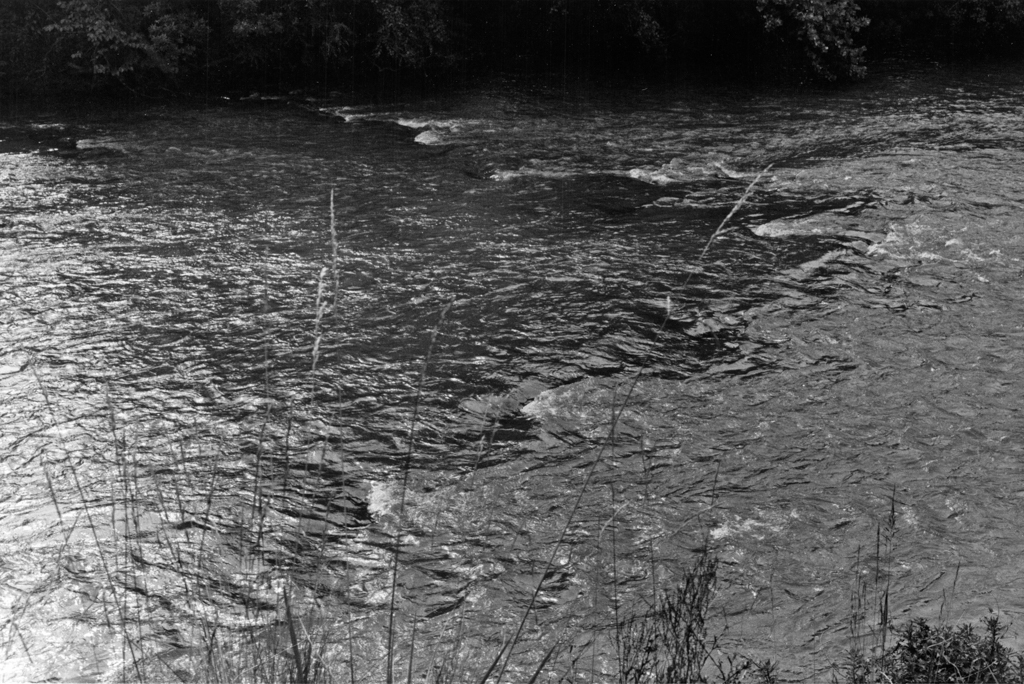
Fish traps are visible and poignant reminders of the late Woodland Era (900–1600 CE) of Virginia's Native Americans. To harvest the fish, they used large boulders to form a V-shaped dam pointing downstream. The Reverend John Banister reported on the use of fish traps during a trip he made to Virginia in 1677: “We make a Dam of loose stones (where there is plenty at hand) across the river, & in it, one, two, or more pipes or tunnels [are placed] for the water to pass; at the mouth of which is set a pot of reeds, wove in the form of a Cone, whose base is about three feet & altitude ten into which the Swiftness of the current carries the fish, & wedges them so fast they cannot possibly return.” Settlers also built these dams. The Martinsville Fish Dam, however, is probably associated with a nearby Woodland village site of the fourteenth century. The best time to view the dam is in autumn when the water is low.
Martinsville Fish Dam
c. 1300. Smith River, just downstream from Rives Rd. Bridge and Walker Rd.