

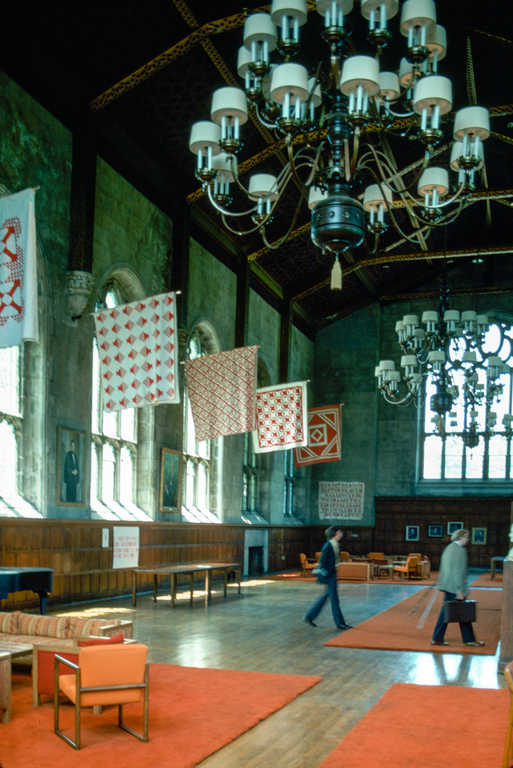
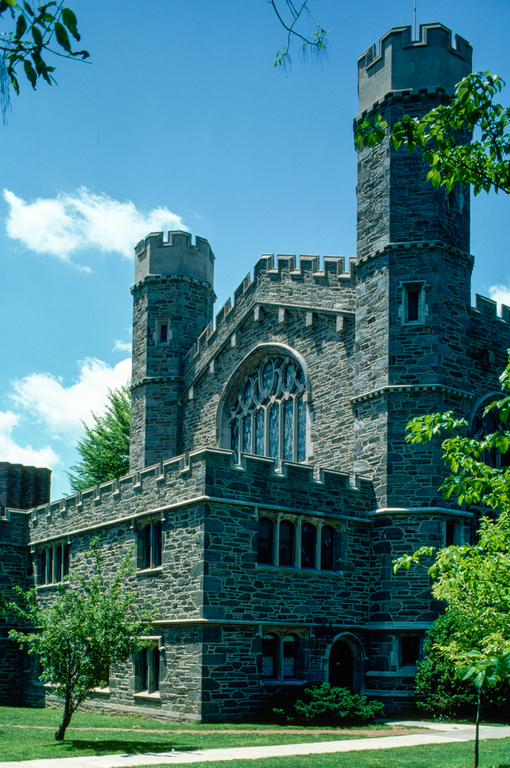
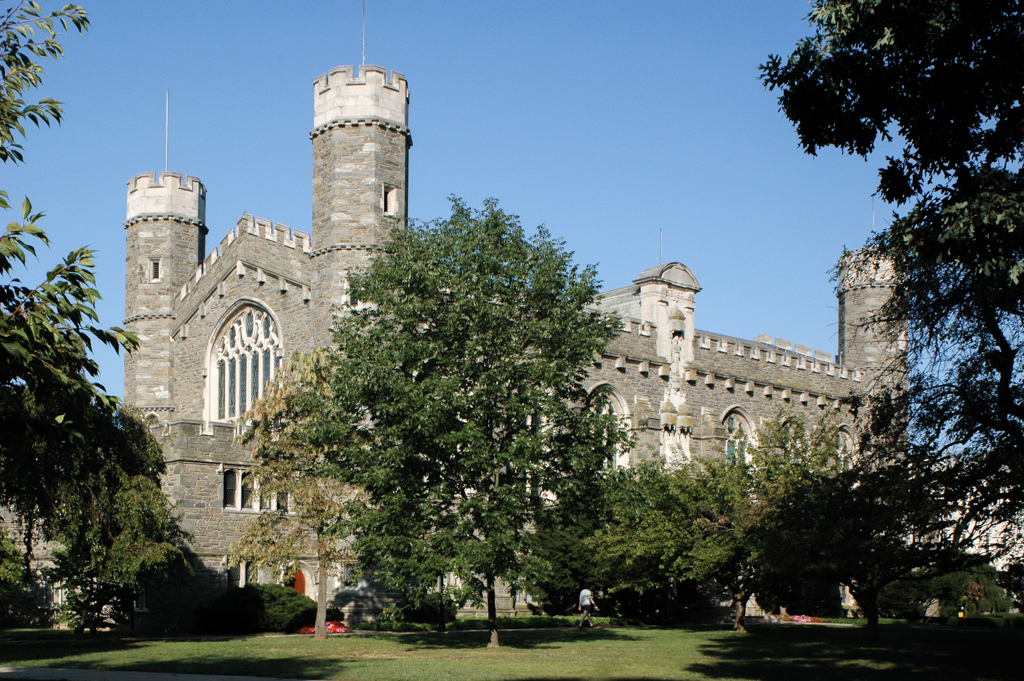
The later buildings, especially the library represent the vision of the college's first woman president, M. Carey Thomas, who demanded that women's educational facilities should equal if not exceed those accorded to men. If the best was the University of Oxford, why then, Bryn Mawr would re-create Oxford. The library, later named for President Thomas, was based on the medieval dining hall of Oriel College, Oxford. It anchored Bryn Mawr in the scholastic Middle Ages. Unfortunately, the great dining hall was not a good modern library—too noisy, too disconnected from the book collection, but the great hall with its oak paneling below leaded glass windows and ornamented with a decorative painted ceiling by Winsor Soule is memorable. The low wings that extend the library into its landscape house faculty offices and frame an interior courtyard whose perimeter arcade is lined with plaques to notable “Bryn Martyrs” (as they call themselves), including a tiny plaque engraved “MCT” above the interred ashes of President M. Carey Thomas, before which burns a lantern. The courtyard is the site of the college's “Lantern Night,” when first-year students are introduced to the campus rituals. With the construction of a new library in the 1960s, Thomas has been in search of a mission. After a desultory rehabilitation by Voith and McTavish in the 1990s, it now functions as a sort of formal campus great hall, with the art history library removed to a new, lightfilled ultramodern wing by Henry Myerberg at the west end. Nonetheless, Thomas Library remains central to Bryn Mawr's self-image and forms a telling comparison to the contemporary choices of the University of Pennsylvania where Provost Charles C. Harrison was building a student union (
PH147.6) and a football stadium (
PH147.9).
M. Carey Thomas Library
1901–1904, Cope and Stewardson