

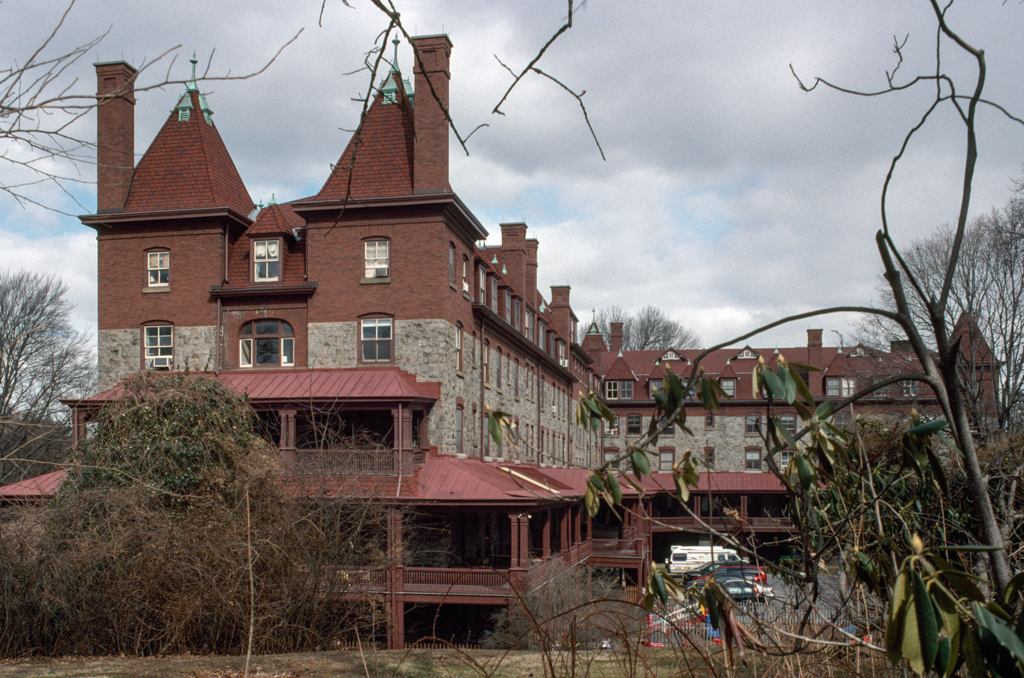
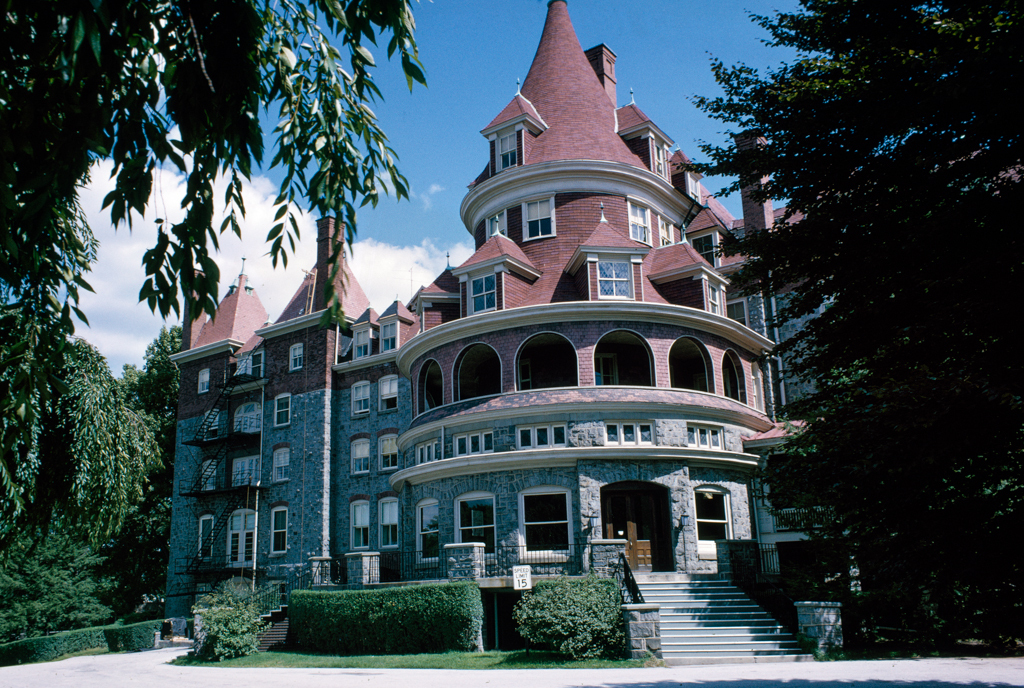
After an earlier hotel by Wilson Brothers burned, Frank Furness built a successor on the original site. The conical red shingle roof above the projecting semicylindrical entrance bay of the Bryn Mawr Hotel is capped by an immense weathervane that was intended to be visible to arriving guests from the nearby station of the Pennsylvania Railroad, the hotel's builder. The weathervane and front tower still dominate the facade, but the building is now approached through a splendid twentieth-century classical iron and stone gate that passes across a deep green which frames the
In the mid-1890s, the building was leased to the Misses Baldwin for their school for young women. Then, in the 1920s, the railroad sold the building to the school, which has since carefully and judiciously added to its complex, screening new construction to the rear of the main building while conscientiously preserving the front lawns as a contribution to their community.
Just west at Yarrow and Morris avenues is the Shipley School (1906, Baily and Bassett) founded by the Misses Shipley as another school for young women; it has recently become coeducational. Its Colonial Revival red brick buildings play on the colonial history of the region and its later translation into the domestic architecture of the early twentieth century.