

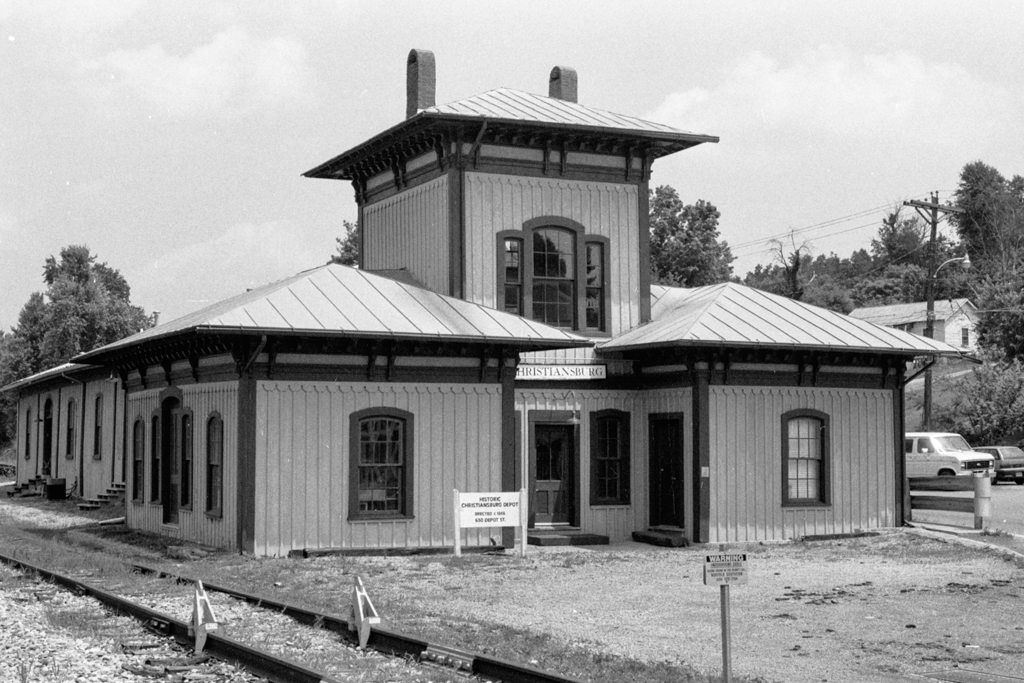
When the Virginia and Tennessee Railroad arrived in the 1850s, it located the regional depot at Cambria about a mile north of Christiansburg where the grade was more suitable. Now part of Christiansburg, in 1906 Cambria was the third-largest town in the county, a standing that led to an unsuccessful attempt to seize the county seat from Christiansburg. A commercial district grew around the depot square and continued along Cambria Street. This Italianate building, which replaced the station of 1854 that burned during the Civil War, is one of the more elaborate built along the rail lines of the 1860s that William Mahone consolidated to form the Atlantic, Mississippi and Ohio (AM&O) (see
DW16
) in 1871. The board-and-batten depot features a distinctive two-story central tower set behind a projecting front bay, hipped roofs, and deep bracketed eaves. Relegated to use as a freight station with the construction of a new passenger depot in 1906 and then retired in 1965, it was restored as a commercial space and once again painted in the original light-olive and dark-red paint scheme.
Cambria Depot
1869. 630 Depot St.