

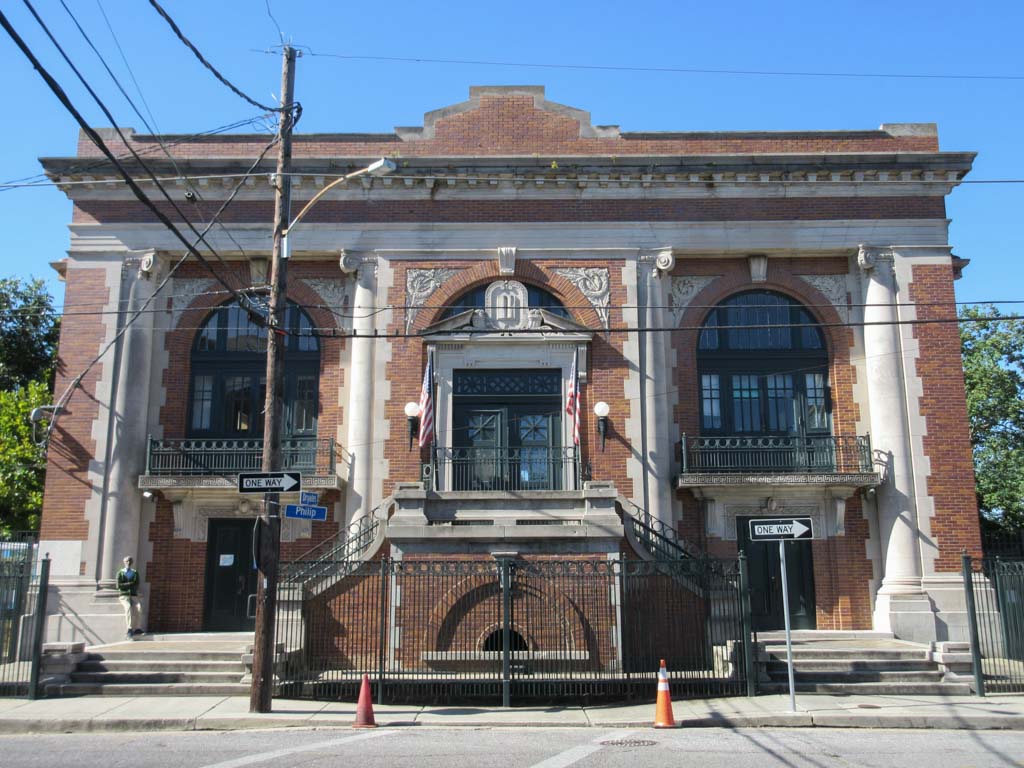
An Andrew Carnegie grant in 1912 funded this library for African Americans on a site at the termination of Oretha Castle Haley Boulevard (formerly Dryades Street), a location proposed by black civic leaders and one that gave the building a highly visible presence. Constructed of red brick with decorative details of Bedford, Indiana, limestone, the facade imitates a triumphal arch, with three wide, round-arched bays framed by Ionic pilasters. An elaborate classically inspired portal is set in the central bay. The sculptural details include an open book, wreaths, and decorative capitals. Initailly, a children’s reading room was located to the left of the central entrance and an adult reading room to the right; an auditorium was in the basement. The library opened with 5,649 books, increasing to 13,000 by 1932. The Dryades Street Branch Library was the only public library in the city available for African Americans until 1953 when the Nora Navra Branch at 1902 St. Bernard Avenue was constructed. Orleans Parish libraries were desegregated in 1955, although restrooms and water fountains remained segregated for several years. Of the six original Carnegie-financed libraries in New Orleans, three of the buildings survive: the Napoleon Avenue (see
OR161
) and Algiers Point branches still function as libraries, but the original branch on Canal Street (
OR91
) has found a new use. The Dryades Street Library, architecturally the most handsome of the surviving group, closed in 1965 following damage from Hurricane Betsy; by then, the city’s libraries were integrated. A YMCA uses the building for activities. William R. Burk (1888–1961) was the architect for many public and institutional buildings in southern Louisiana.
Historic Dryades Street Branch Library
1914–1915, William R. Burk. 1924 Philip St.