

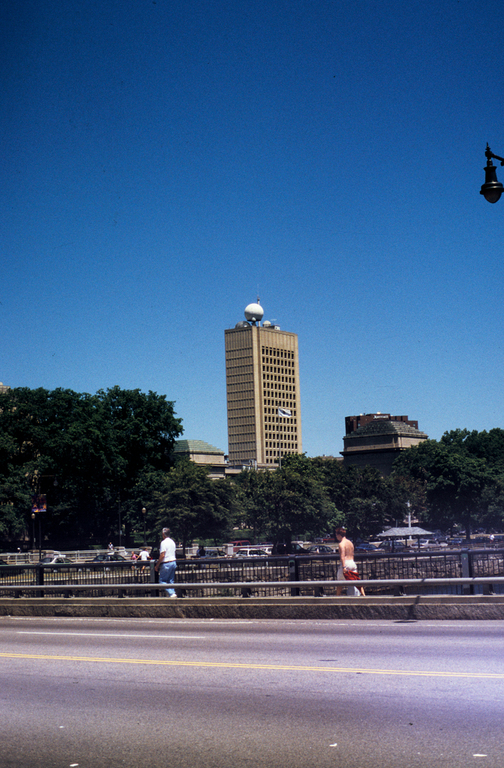
The twenty-three-story tower is an MIT landmark, easily recognizable by its crowning sphere and spire, symbolic radar and weather equipment, and at ground level by Alexander Calder's forty-foot-high black-painted steel The Big Sail (1965). Massive but light, straight but curved, flat but plastic, Calder's dynamic stabile may stand as a metaphor for the meteorological signs at its apex, as do the unintended wind tunnels at the entrance. The dominant focus of a quadrant planned by Pei, this concrete monolith is notable for its bridgelike structure, especially as defined by its triple openings at ground level, which also serve as pedestrian passages. The heavy load-bearing end walls support the column-free floors, whose openings are pierced by series of deeply set windows. Pei's vertical structure acts as an organizational element to unify the surrounding horizontal Dreyfus (MT8) and Landau (MT9) buildings, siting the whole complex directly on axis with the Prudential Center (BB79) across the river and contrasting with the more chaotic state of other parts of the campus.
Green Center for Earth Sciences (Bldg. 54)
 Keith Morgan
Green Center for Earth Sciences (Bldg. 54)
1964, I. M. Pei assisted by Araldo Cossutta; Sasaki, Dawson, DeMay, landscape. Access via 21 Ames St.