

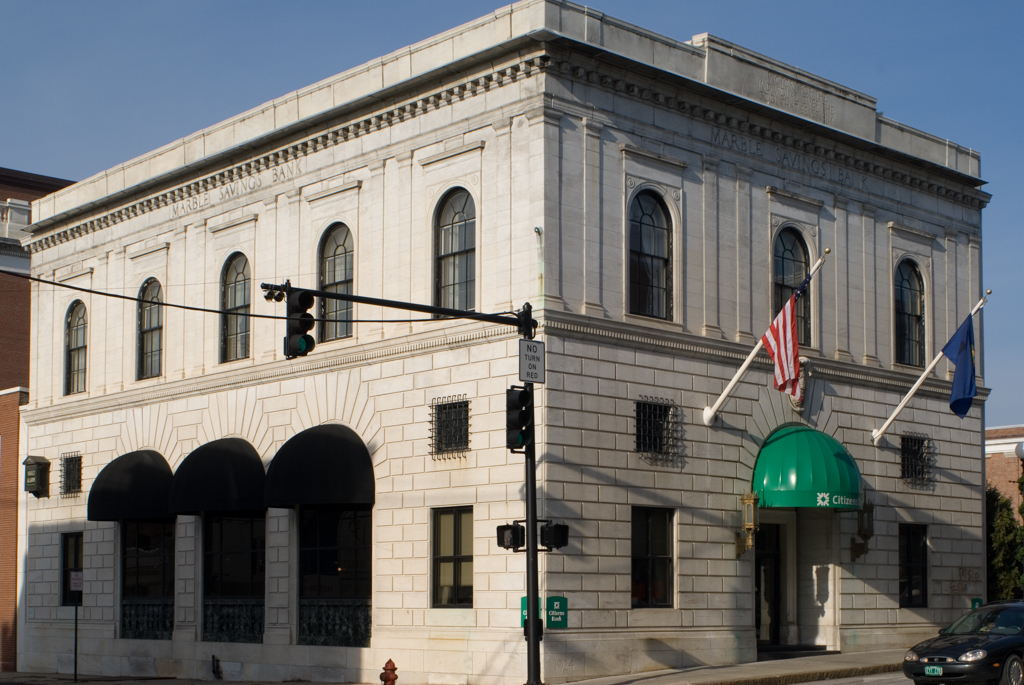
This bank demonstrates that Vermont marble, which played an important role in City Beautiful public and commercial architecture across the nation, was also used close to its source—white Danby marble from the Vermont Marble Company. Sharing in the prosperity of the national financial industry in the early twenties, the bank traded its quarters in the Mead Building (RU40) for a grand Italian Renaissance design at this busy commercial intersection. Here Buffalo, New York, bank specialist Cook drew on his Beaux-Arts training to combine, on the Merchants Row facade, a carefully patterned rusticated ground floor and mezzanine reminiscent of a sixteenth-century Florentine banker's house and, on the West Street side, a Venetian palazzo with an upper floor of paired pilasters and window frames quoting the fifteenth-century Cancelleria in Rome. The opulence and refinement of the Beaux-Arts aesthetic would fall out of favor with the stock market crash that followed five years later.
Citizens Bank (Marble Savings Bank)
1924, Harold J. Cook. 47 Merchants Row, City of Rutland