

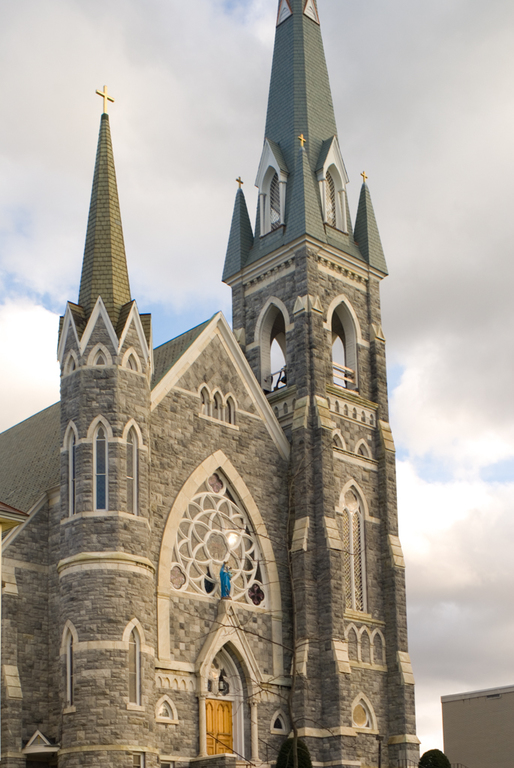
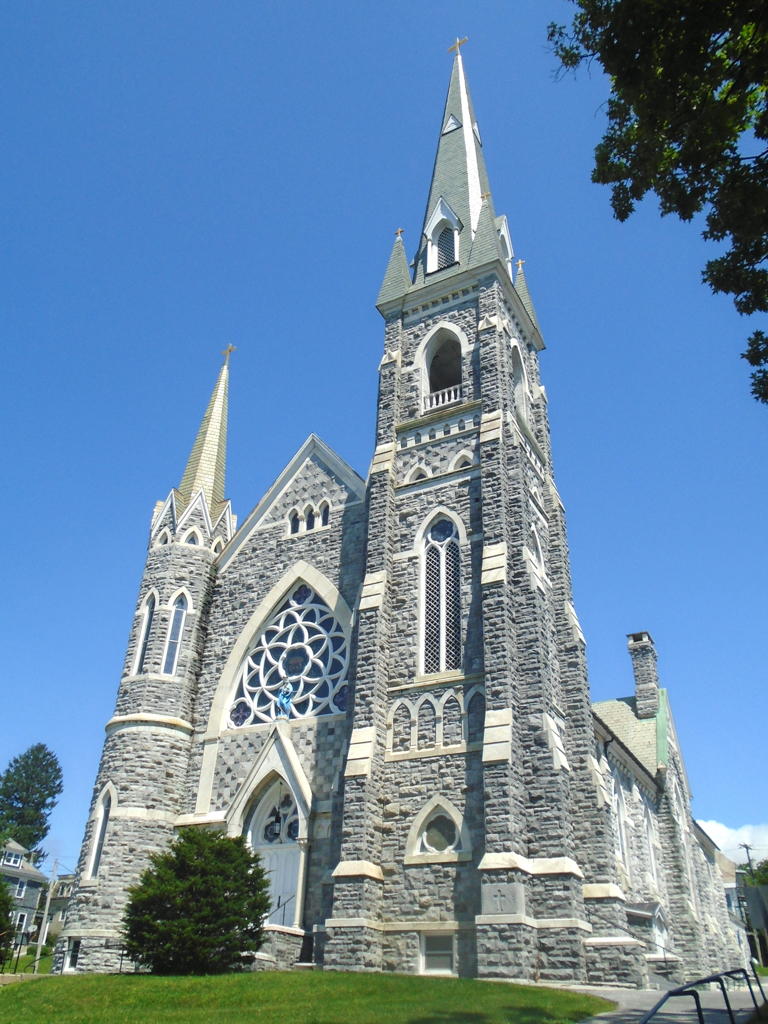
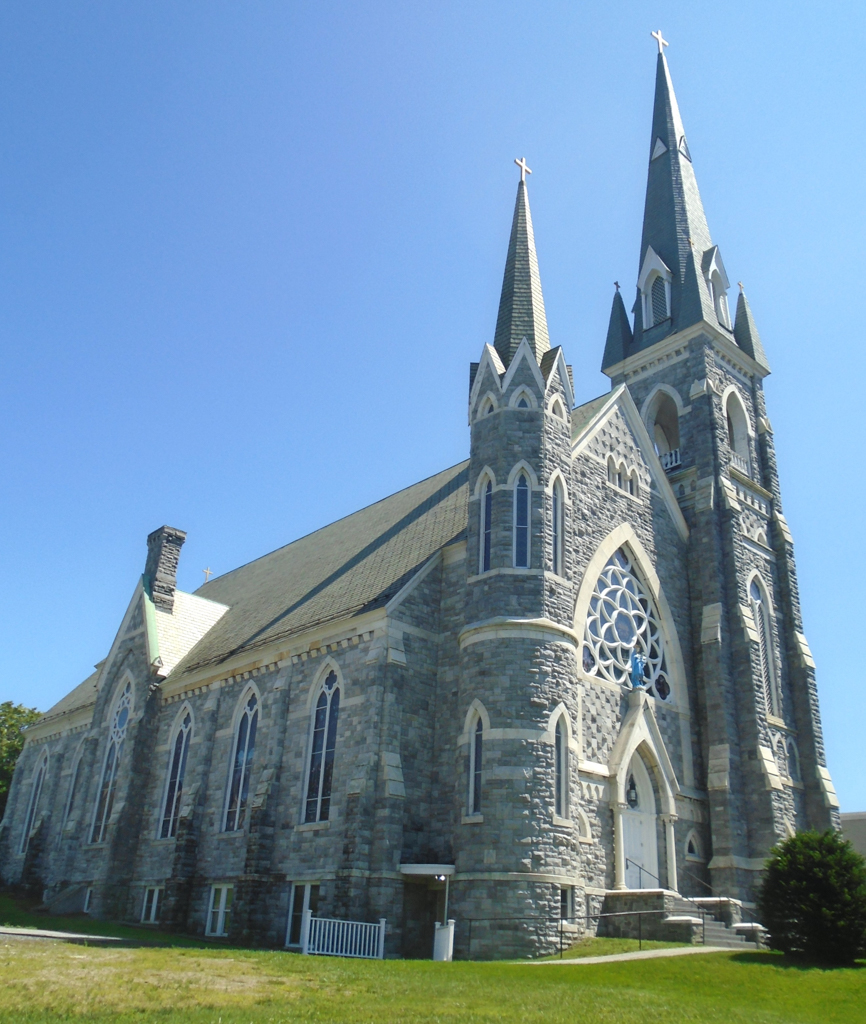
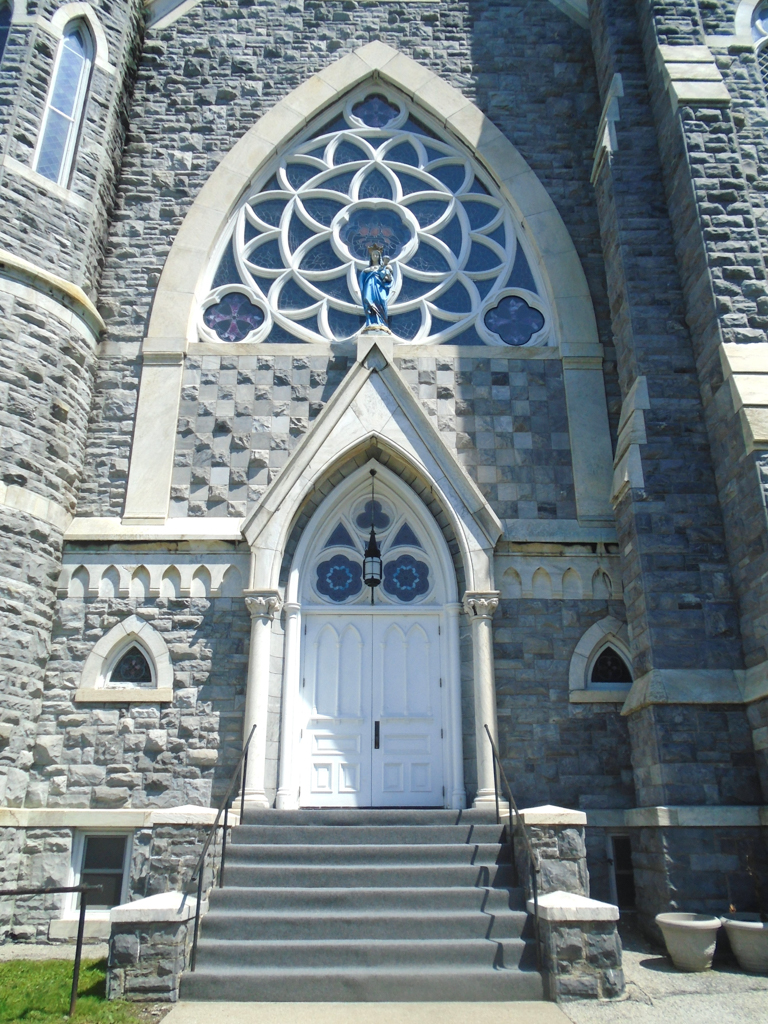
Rutland marble allowed George Guernsey to create one of his most notable churches. The Montpelier architect-builder had worked in wood frame, brick, and stone for Vermont's Roman Catholics in the 1880s and 1890s at Bellows Falls (1885; WH9), St. Johnsbury (1887), Montpelier (1892), and Woodstock (1894). This church was for Rutland's French Canadian community, which grew when Canadians arrived to break a strike by Irish marble workers in 1867–1868. Because of the bitterness this generated, they developed their own neighborhood north of West Street and in 1870 built a frame church on the newly opened Lincoln Avenue. Its far grander successor combined French Romanesque and Gothic forms in richly worked marble. The gabled west facade is picturesquely composed with differently sized and shaped corner towers, circular to the north and larger and square on the south. The gray, rock-faced marble is enlivened by Guernsey's characteristic love of polychromy (the trim is in white marble), textures (checkerboard and diaper fields that alternate smooth and rock-faced squares), and repeated pointed arch motifs on varied scales. The grandest of the arches frames the great western rose window, its angles filled with quatrefoil lights. Consistent with the richness of the facade is an interior with polychrome stenciling on plaster groin vaults and fine stained glass.
Immaculate Heart of Mary
1894, George Guernsey. 16 Lincoln Ave., City of Rutland