

A product of the self-conscious nostalgia that ruled Bennington's genteel patrons in the early twentieth century, the brick and marble library embodies a distinctively “Old Vermont” expression of Colonial Revival. The library initially occupied a two-story brick Italianate commercial structure (c. 1870) on Main Street. At first glance, the major expansion along Silver Street, designed by a relative of the heritage-conscious Park family, is a rather generic Georgian Revival structure. Its symmetrical massing, careful proportions, and masonry construction indicate accurate contemporary knowledge of colonial public buildings in such places as Philadelphia and Williamsburg. But the building also contains specific references to early Vermont. By the architect's own account in the Bennington Evening Banner (April 25, 1936), the lantern is based on that of the long-lost Old Bennington courthouse; the door is derived from that of the Rockingham Meeting House (WH7); the Palladian window invokes the church in Weathersfield; and the windows are modeled on those in the Munro and Robinson houses (
BE12
,
BE25
) in Shaftsbury and Old Bennington. The decorative cornice repeats that of the Painter House in Middlebury (AD23), and the chimneys come from the Stateline House in Halifax (WH55). It is a deliberate pastiche that pays homage to the state's Georgian and Federal monuments.
Bennington Free Library
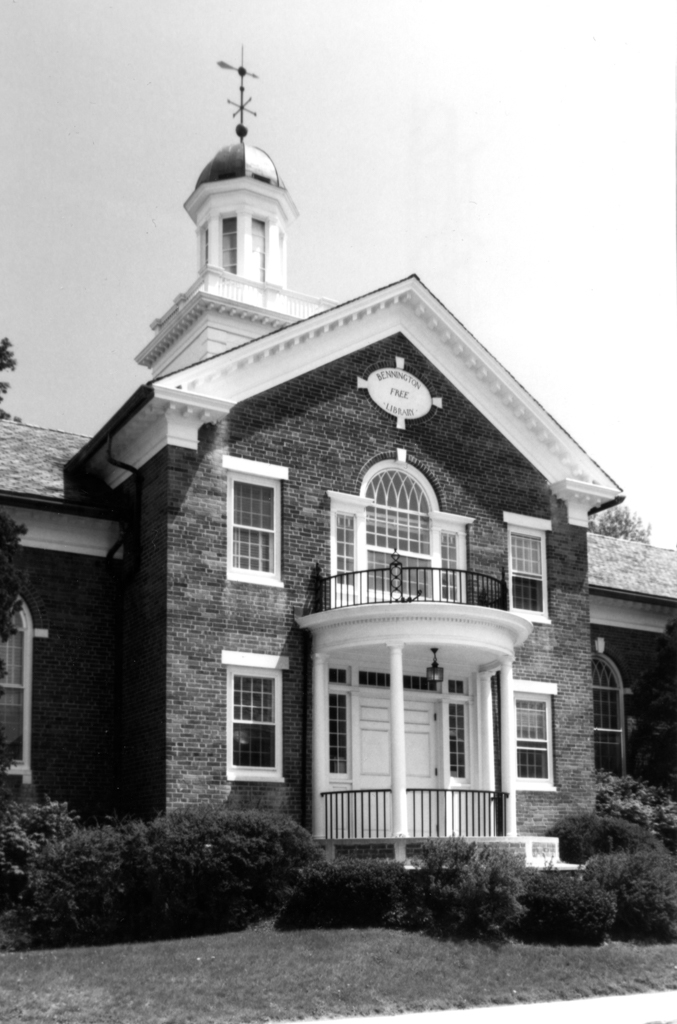 Photograph by Curtis B. Johnson, C. B. Johnson Photography
Bennington Free Library
c. 1870; 1935–1936 addition, Herbert Thornton Turner. 109 Silver St., Bennington village