

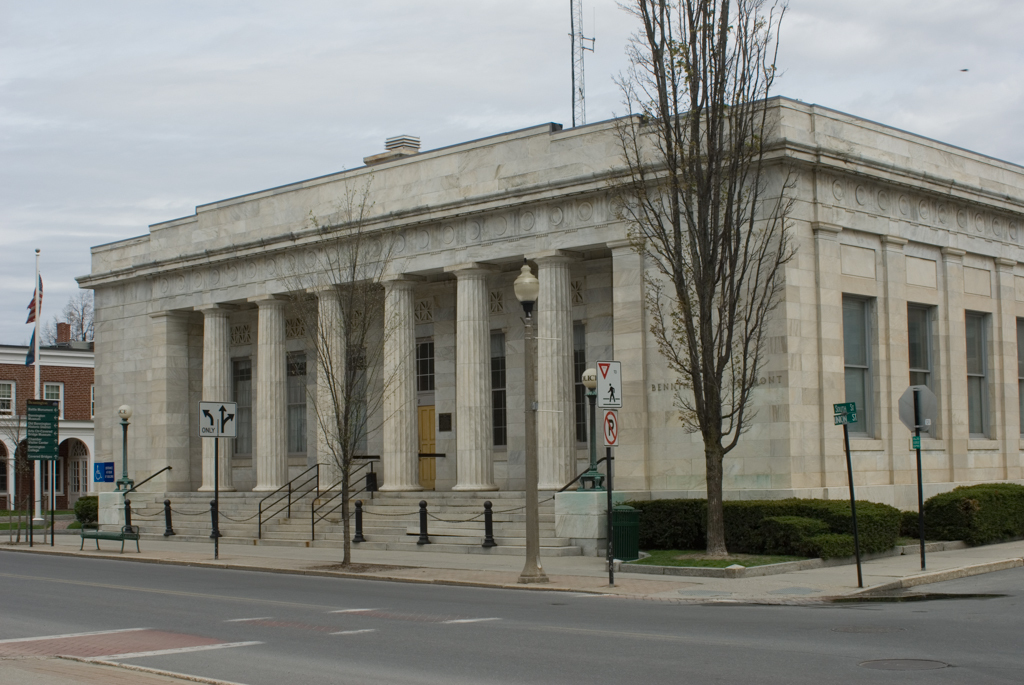
Along with a similar, if simpler, U.S. Post Office and Custom House (FR17) in Richford, this is among the last works designed for the Treasury Department under James Knox Taylor. Executed during the tenure of his successor, Oscar Wenderoth, the handsome building reflects the mainstream Beaux-Arts connections of both supervising architects. At the time, while large federal projects were awarded to regional architects by competition, minor ones like this were designed in-house to meet Taylor's twin goals of dignified representation of the federal government and respect for regional heritage. In spite of Bennington's emergent passion for the Colonial Revival, for Taylor this building required a Greek Doric facade and white Vermont marble cladding that appear to refer to prominent local Greek Revival work like the designs of Hiland Hall (BE36). The building uses a typical Beaux-Arts mix of classical vocabularies. These include a sophisticated composition with basement as podium, a hexastyle-in-antis colonnade flanked by slightly recessed blind end walls, Roman column bases and paterae as metopes, tall sash windows, and pilasters lining the south facade. With its stepped parapet and markedly planar handling of wall surfaces, it projects an almost 1930s modern classicism. Taylor intended such buildings to be lasting monuments to democracy, and the unaltered exterior of this one remains impressive.
Bennington Police Department (Federal Building)
1913–1914, James Knox Taylor and Oscar Wenderoth, Supervising Architects of th U.S. Treasury. South St. at Union St., Bennington village