

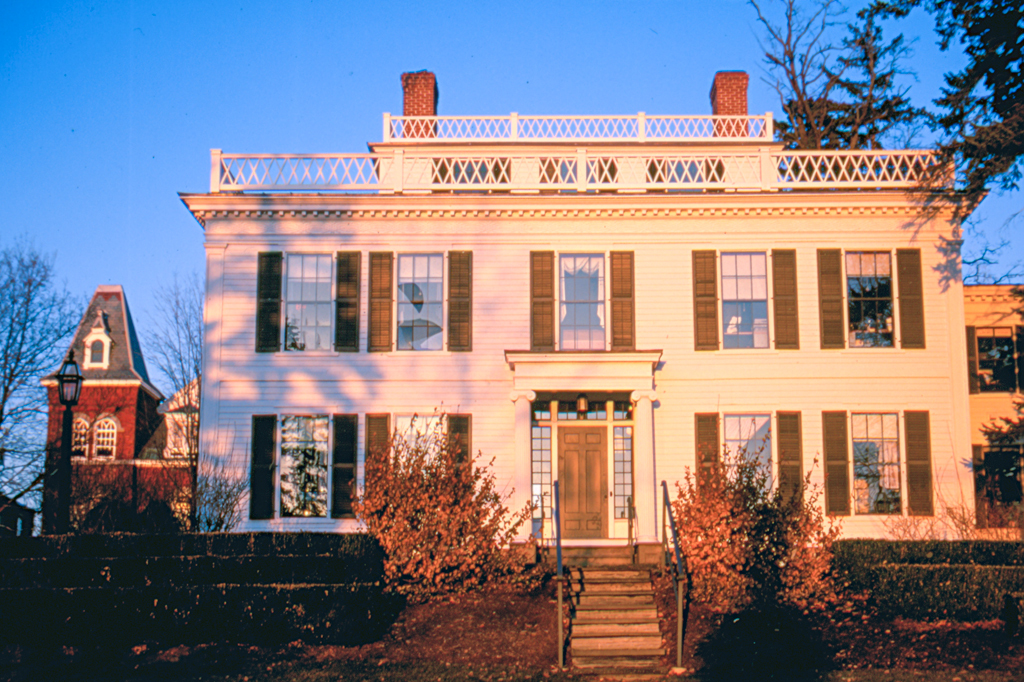
The Gamaliel Painter house is the second residence to occupy this prominent site at the head of Merchants Row, overlooking the village green and adjacent to the site of the original Addison County Courthouse. Its predecessor, the first frame dwelling in Middlebury, was built in 1787 and moved to 7 Seymour Street in 1802 upon the completion of Painter's new house. This Georgian-plan house established the model for Middlebury's grand residences during the next two decades. Its distinctive massing combined a rare roof monitor with an almost flat roof deck from which Painter watched over his village. These characteristics, shared by a documented, but lost, contemporary house, suggest that Painter's house was the work of mid–Hudson Valley joiner Coe. Originally, the house faced the green, but when the Center Turnpike (now U.S. 7) opened at his back door, Painter decided to add a principal facade to the rear as well. In 1813 the fanlit Court Street entrance, originally with a hood like that of 88 Main Street (1804) and 3 Main Street (1816), was completed, and the rope-molded pilasters, scrollwork frieze, and stringcourse were likely added by Lavius Fillmore, whom Painter had brought to town to build the Congregational Church (AD21). Subsequent owners gave the leaking roof a new pitch in 1823, removed a three-part window toward the green, and enlarged and shifted all remaining windows. In the 1840s the front door and rear parlors were reworked in the Greek Revival mode, and in the 1880s and 1920s the interiors were remodeled according to Victorian and Colonial Revival preferences, respectively. Currently, the house has been restored to its 1920s appearance, leaving each layer of its history evident.
Painter House
1801, attributed to Samuel D. Coe; later alterations. 2 Court St., Middlebury village