

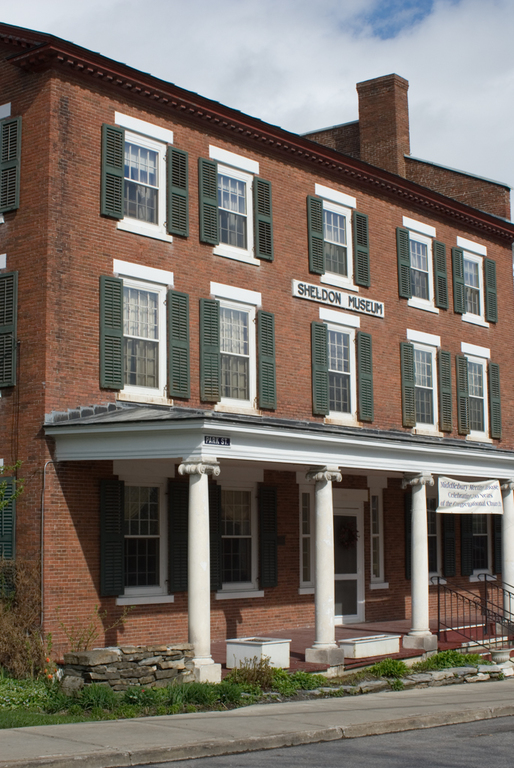
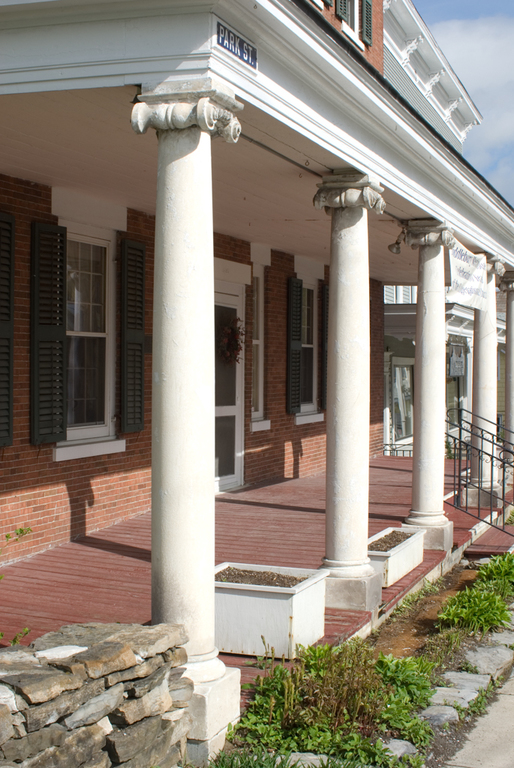
This grand house was built for the owner of the nationally significant Middlebury Marble Works as a showplace for his wares. In 1802 Eben Judd perfected a method for the water-powered sawing of marble (by means of toothless soft-iron blades that dragged sand across the cut) and opened a mill in Frog Hollow adjacent to a vein of marble whose quality was likened to Carrara. Soon he was shipping slab and turned marble goods from Quebec to Georgia and, eventually, out the Erie Canal. Judd established supplemental workshops in Vergennes and in Auburn, New York, and retail outlets in Boston and New York City. Perhaps his most important products were columned and paneled fireplaces used by architects Charles Bulfinch, Ammi B. Young, A. J. Davis, and others and found today in centers as disparate as Salem, Boston, and Nantucket, Massachusetts; Portsmouth, New Hampshire; and Middletown, Connecticut. Business boomed, especially after 1828, when Judd opened a quarry in Shoreham that was reputed to be the only source for pure black marble in the United States. Judd's house introduced rectangular instead of trapezoidal marble lintels, marking a transition from Federal to more Greek Revival tastes in Middlebury. Its unusual piazza displays a series of turned marble columns with carved Ionic capitals. The fireplaces inside present a full range of plain, paneled, and columned types in prized black marble. Since 1882, the Judd house has been the home of the Henry Sheldon Museum.
Henry Sheldon Museum (Judd House)
1829; 1990 rear addition, Michael Hassig. 1 Park St., Middlebury village