

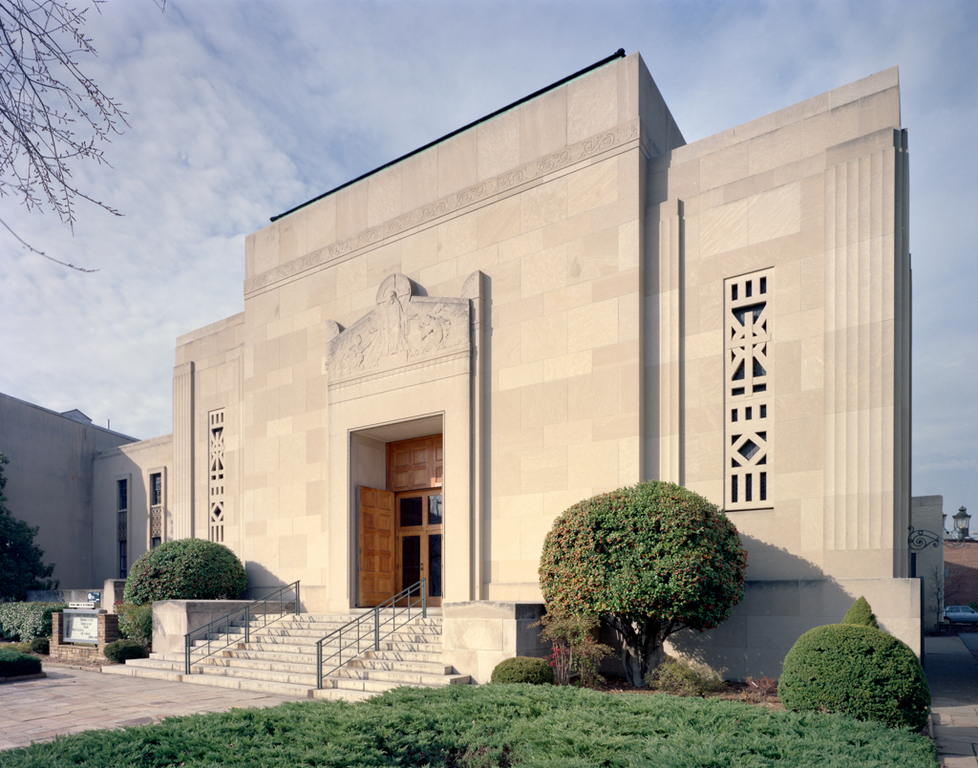
This church, classical in its massing and modern in its details, contrasts with the more typical nineteenth-century churches on Capitol Hill. It derives some of its presence from its location directly across East Capitol Street from Paul Philippe Cret's Folger Shakespeare Library. The Lutheran church's monolithic buff limestone exterior is composed of a sparsely articulated central cube projecting from and rising above a lower rectangle, the intersections marked by modern fluted pilaster strips and the corners by full-width pilasters. Single vertical windows, with limestone screens composed of Latin and Celtic crosses superimposed over Xs (the initial letter in the Greek spelling of Christ), admit light into the narthex. Additional classicizing details are the acroteria at the corners of the massive door frame and a frieze that marks the cornice line of the main block; its relief decoration shows symbols of the twelve apostles and grapes, symbolic of communion. The sculptor of the pedimental relief of the enthroned Christ is unknown.
While the exterior fuses classical and modern, the simple interiors with their subdued, well-crafted furnishings are primarily late Arts and Crafts in style. In the narthex the upper walls of rough plaster are divided from the simple oak paneling by a stenciled dado of abstract crosses. Eighteen historical variants