

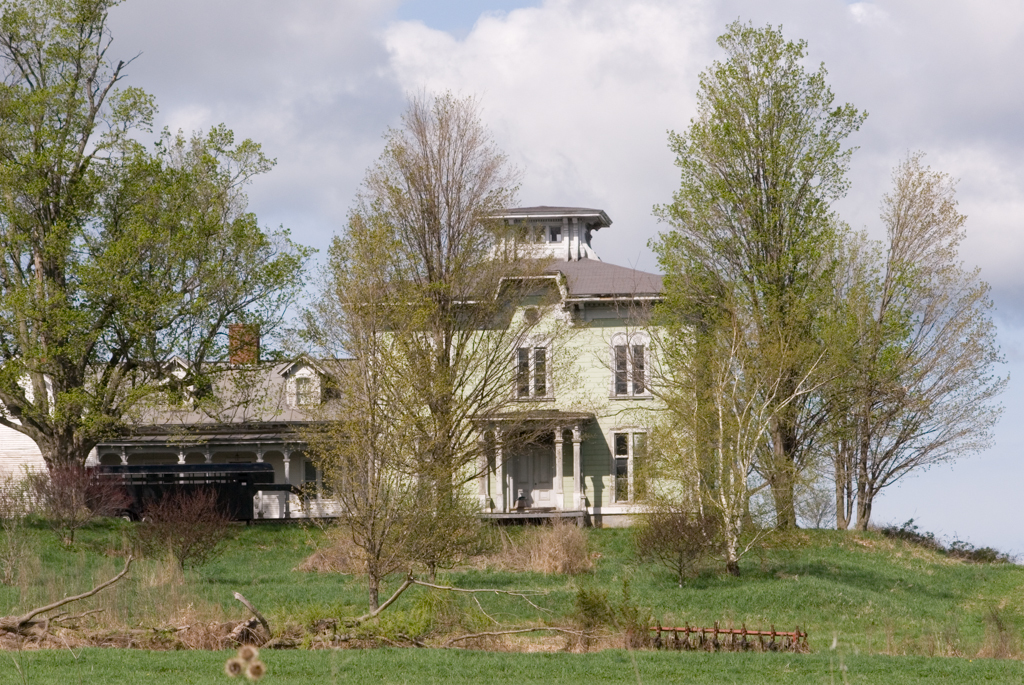
Stonehenge is a farm that was remodeled c. 1870 by Colonel Edwin S. Stowell into a showpiece stock farm for Merino sheep and “gentlemen's driving horses.” Its dramatic site, visible atop a hill from VT 30 and VT 74, may have inspired Stowell to name it after the ancient monument on Salisbury Plain in England. Smith designed the wood-frame house and farm buildings as an Italianate group, and they were pictured in F. W. Beers's county atlas of 1871. The main house is a fairly typical, two-story palazzo, with a belvedere and the distinctive ornate trim of the Smith and Allen mill in Middlebury. Attached to it is a c. 1810 Cape-type farmhouse used as a kitchen and ell connected to the bargeboard-trimmed carriage barn. Across the drive are the original, connected horse, sheep, and cow barns, all with board-and-batten siding and once topped by Italianate cupolas. These are now partially engulfed by a large twentieth-century, gambrel-roofed, ground-stable dairy barn and sheds. A rare farmyard design by a local architect and a highly visible local land-mark, Stonehenge is an excellent example of the prosperous stock farms of late-nineteenth-century Addison County.
Stonehenge Stock Farm
c. 1870, Clinton G. Smith. End of Lambert Rd., off VT 30