

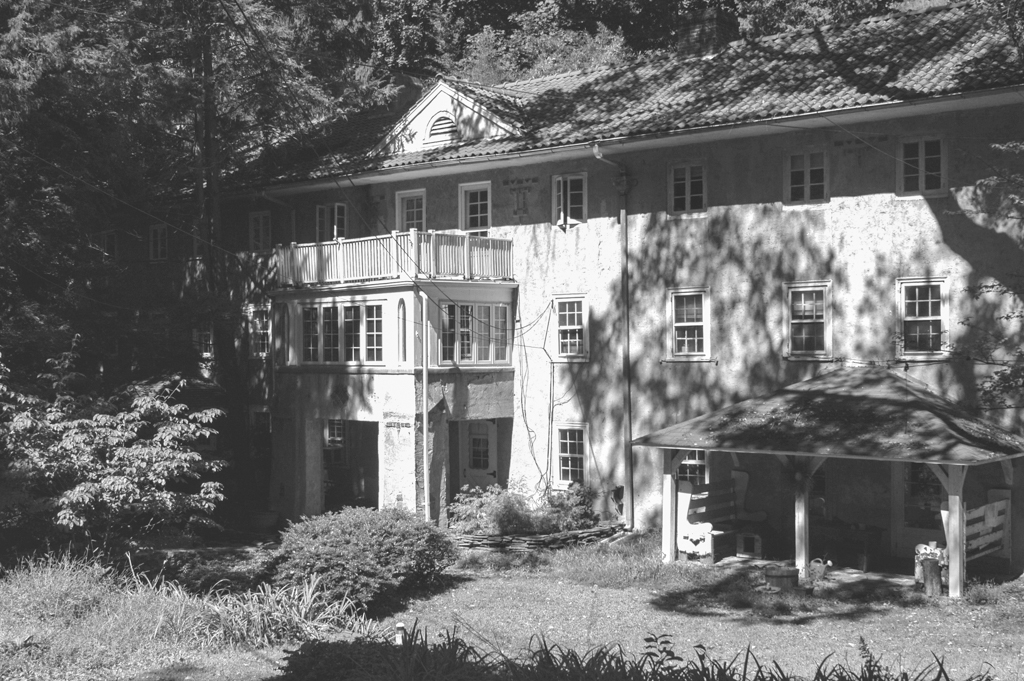
Under William Price's regime, the managers’ twin houses were adapted to serve as housing for workers in Rose Valley's shops, while the
Price and his family lived in the Guest House until they purchased the adjacent Victorian house, which they partially modified in his modern manner. The ruins of the larger mill by Ridley Creek was adapted to serve as an Arts and Crafts workshop where museumquality Rose Valley furniture was made, while the smaller snuff mill on Rose Valley Road became a community Guild Hall with artists’ studios and a kiln where William P. Jervis worked for a year. Other artists were drawn to live in the community, among them William Grey Purcell, whose low, brown clapboarded Prairie Style house can be seen from Rabbit Run Road off Possum Hollow Road.
At Rose Valley, Price returned to the free style that he had learned with Frank Furness, but with a significant difference. All of the original buildings shared a common vocabulary of rubble stone with stucco made yellow by the local creek sands. This resonated with Price, who, recently returned from a trip to England, saw the merits of unification of place through materials, an idea that he discussed in “The Value and Use of Simple Materials of House Building” (1905). “The advantages of the use of common and rough local materials seem to me to be three-fold. First, they are cheap; second they are easily obtainable and third, they are beautiful [because they tend] to produce types—tends toward a pleasing homogeneity in local style that is altogether good.” Rose Valley exhibits just such a “pleasing homogeneity.”