Trinity Cathedral and Graveyard, and First Presbyterian Church

Trinity Cathedral and Graveyard, and First Presbyterian Church

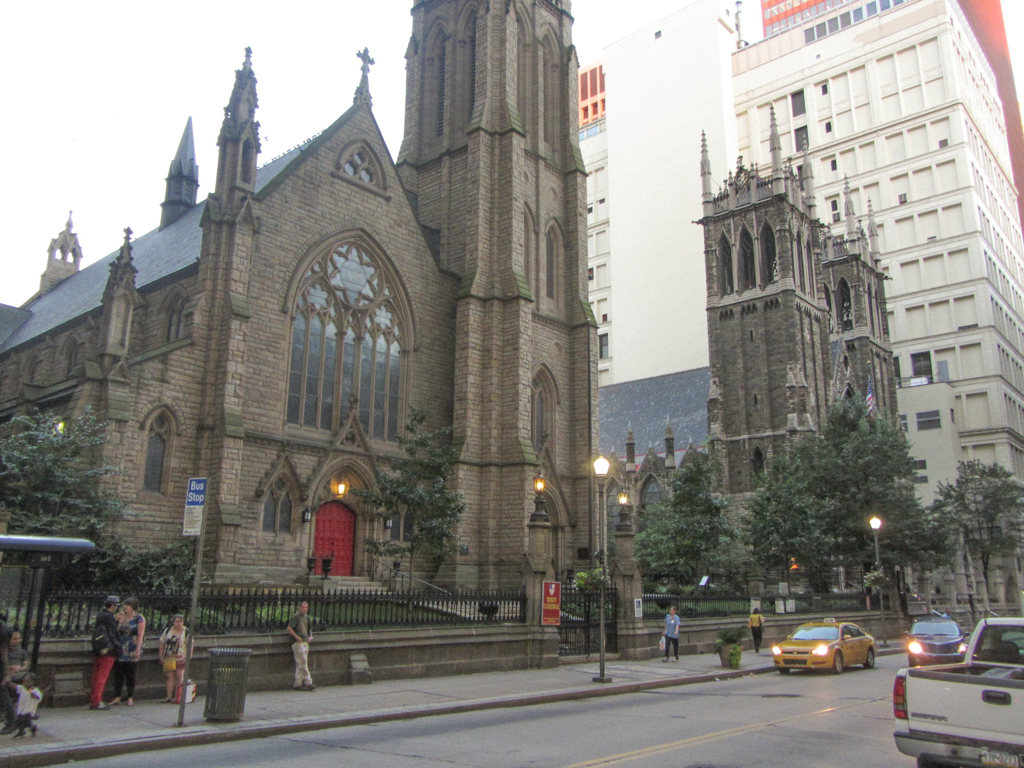
Trinity Cathedral at left, First Presbyterian Church at right Photograph by David Wilson, CC BY 2.0

Trinity Cathedral at left, First Presbyterian Church at right

1872 Trinity, Gordon W. Lloyd; 1905 First Presbyterian, Theophilus P. Chandler Jr. 328 and 320 6th Ave.

In 1787, the Penn family donated four lots on 6th Avenue for the congregations of Pittsburgh. Though several different churches have been constructed on the plot, an Episcopalian and a Presbyterian congregation worship on the site to the present day. The Episcopal congregation's first church, an octagonal structure, was at 6th and Liberty avenues. The second church, designed in 1824 by John H. Hopkins, the congregation's rector, was one of the earliest Gothic Revival churches on the continent, and the first in Pittsburgh. That structure was razed in 1869 to allow for the construction of the present stone building by English-born and trained, but Detroit-based, architect Gordon W. Lloyd (1832–1905). Lloyd's design derived from early-fourteenth-century English Decorated Gothic precedents. Glass from the second church was incorporated into this structure, although some was replaced after a fire in 1969. Most of the rib-vaulted interior was undamaged. A notable interior addition is the pulpit of 1922 by Bertram G. Goodhue. In 1927, the church was elevated to cathedral status and became the seat of the Pittsburgh Diocese.

First Presbyterian Church, though more recent, has a longer history on the site. The Presbyterians erected a brick structure in 1805, which was rebuilt in 1813 by Benjamin H. Latrobe during his Pittsburgh stay. That structure was replaced in 1851–1853 to a design by Charles F. Bartberger, which was in turn razed when the congregation sold the land for the construction of the Daniel Burnham-designed McCreery Department Store in 1904 (now 300 6th Avenue). The present church, a hybrid of thirteenth- and fourteenth-century English Gothic, clothes a single large meeting hall designed for preaching. First Presbyterian's thirteen Tiffany windows are its glory, while the glory of Trinity is the old graveyard, with tombs from the eighteenth century.

Writing Credits