

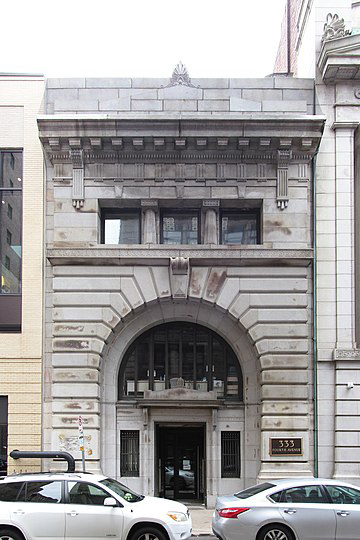
This is the most exuberant of the three bank buildings near the corner of 4th Avenue and Smithfield Street. Next door at 337 4th Avenue stands Daniel Burnham's coldly classical Union Trust of 1898, built for Henry Clay Frick. Beyond, at 341 4th Avenue, stands James Steen's overly fussy Fidelity Trust (1888–1889) in Richardsonian Romanesque.
German-trained Charles M. Bartberger (1850–1939) inherited his architectural practice from his father, Charles F. Bartberger, and passed it on to his son Edward. The three generations practiced architecture in Pittsburgh for well over a century (1845–1956). This bank is one of the most confident handlings of Beaux-Arts classicism in the city. Its facade consists of a huge granite arch whose voussoirs align with sharply cleft breaks in the horizontal coursing. Above, the windows are set in a dwarf mezzanine.
The two blocks of 4th Avenue between Market and Smithfield streets constitute the core of Pittsburgh's former financial district, once second in capital only to Wall Street. Fourth Avenue began life in the Woods-Vickroy plan of 1784, but gained importance only in the