

When landscape architect Charles Eliot envisaged the master scheme for the Boston Metropolitan Park System (1892–1893), he assigned to individual municipalities the responsibility for creating small urban parks and playgrounds. In 1893, the Boston Park Commission gave Eliot his only opportunity to design such a facility for Boston. By the 1890s, the North End was one of the most densely inhabited urban districts in the United States. Through the urging of councilman (later mayor) John “Honey Fitz” Fitzgerald, Copp's Hill Terrace was built as the largest open space in this teeming district. The two granite terraces abut the colonial Copp's Hill Burying Ground (NE13) on one side and North End Park, a bathing beach that Eliot designed across Commercial Street, on the other. As Eliot wrote in sadness to his wife in 1895, Copp's Hill Terrace provided a recreation retreat for “the slum people . . . unclean beings, children pushing everywhere and swarming in every street and alley” (Charles Eliot, Landscape Architect, 485–86).
Copp's Hill Terrace
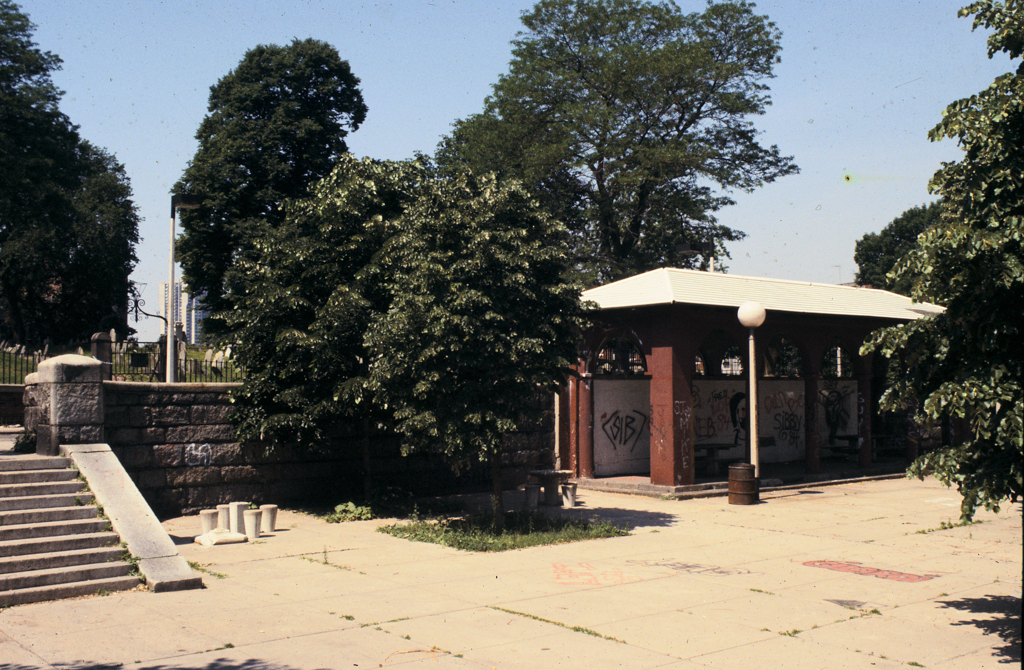 Keith Morgan
Copp's Hill Terrace
1893, Olmsted, Olmsted and Eliot; 1913. Commercial and Charter sts. and Jackson Pl.