

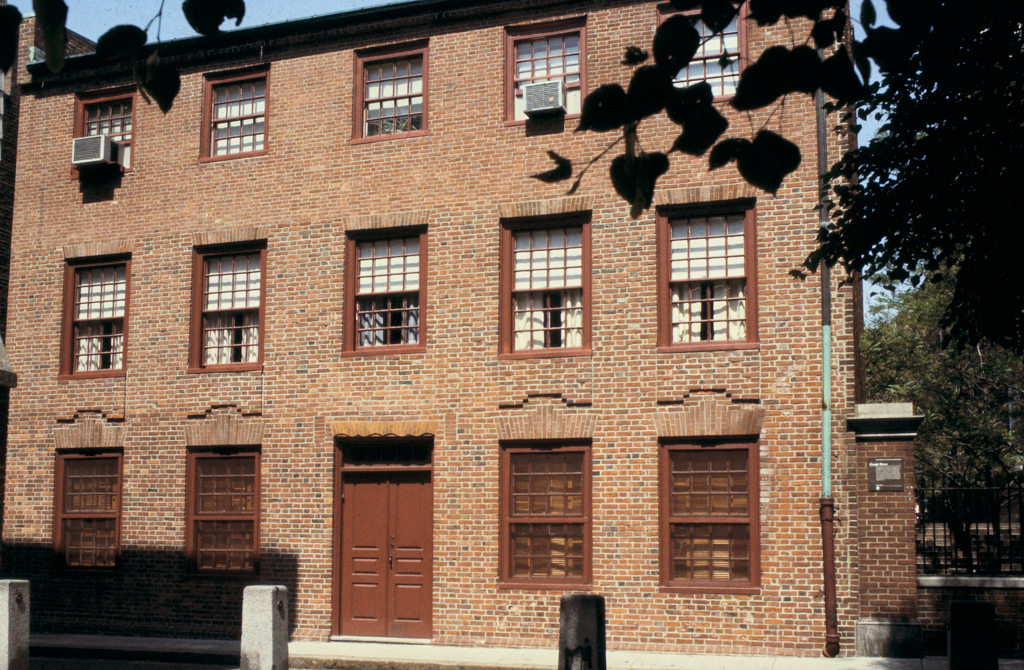
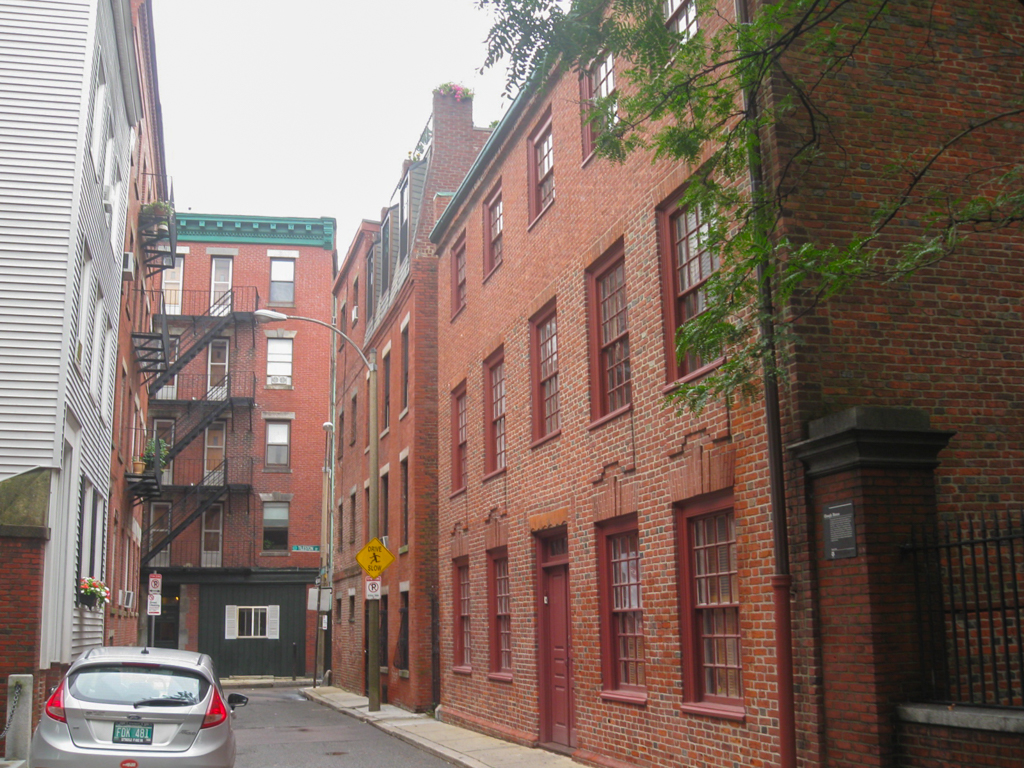
One of a handful of extant brick dwellings built just after the 1711 fire, 21 Unity Street helped introduce English vernacular urban forms that transformed Boston into a brick provincial city. The product of an artisan subdivision of Bennet's pasture after 1703, most of the lots and brick houses were sold within a few years by brick mason Ebenezer Clough or his widow. Clough and housewright John Barret built two-and-a-half-story brick investment properties separated by a party wall. Although Barret's half house is gone, it shared with Clough's a Flemish bond facade, a rubbed and shaped brick door lintel, and projecting brick aprons below the second-story windows. A hooded door head originally surmounted the double front door. Adding a third floor in the early nineteenth century eliminated a gambrel roof and paneled chimneys, and the present sash windows replaced mullioned casements. Clough also worked as a bricklayer on the adjacent Christ Church.
Ebenezer Clough House
1711–1715, Ebenezer Clough, brick mason; John Barret housewright?; early 1800s enlarged; 1960–1964 restored, Charles R. Strickland. 21 Unity St.