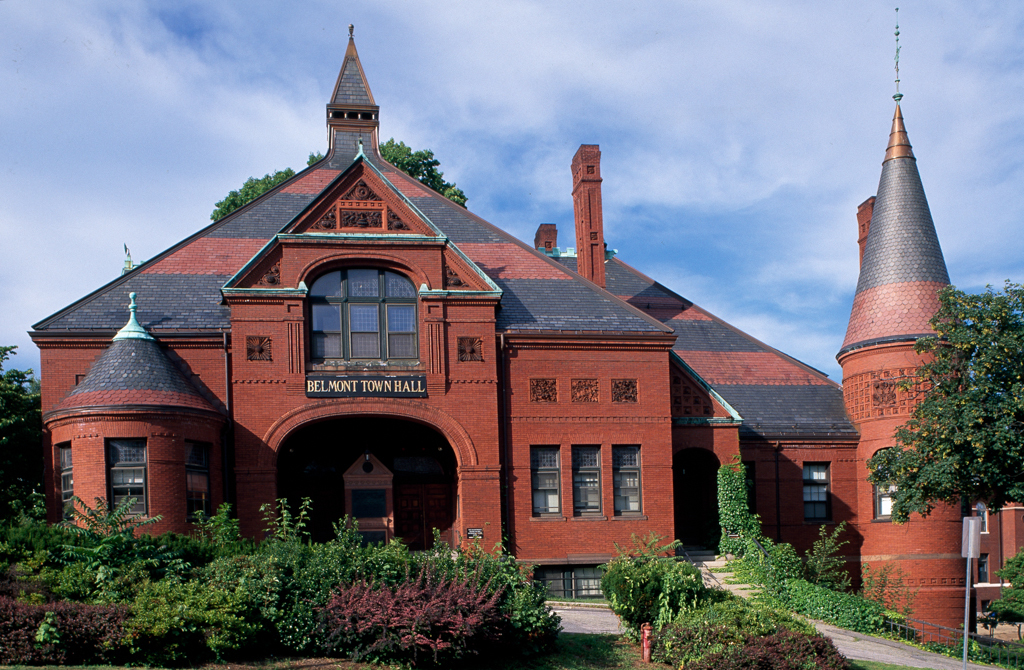
The distinguished historic residential and institutional core of Belmont runs along Pleasant Street at the base of Belmont (formerly Wellington) Hill. Public buildings dominate the western end of this district. Henry W. Hartwell, who formed a partnership with William C. Richardson during the project, designed the Town Hall (1881) at the corner of Pleasant Street and Concord Avenue. Set on a sloping site, the building is especially noteworthy for the fine terra-cotta and molded brick ornament that adorns the broad arches and conical corner tower. East of the town hall stands the former Homer School (1897), now used as the town hall annex. The handsome brick-arched school is the only surviving building in Belmont by Eleazar B. Homer, a member of a prominent local family who trained with Hartwell and Richardson and taught at MIT. Fronting Pleasant Street north of the Homer School is the former public library (1902, William Ralph Emerson), built in a Classical Revival mode of brick with granite ornament. Across Pleasant Street and extending up Belmont Hill, a community of summerhouses evolved from the 1850s on. The most prominent is the William Flagg Homer House (1853), owned by the uncle of the painter Winslow Homer, who spent several years in Belmont. Now owned by the Belmont Womens' Club, the Homer House is a flamboyant example of mansarded Italianate architecture. Moving north along Pleasant Street, one sees a consistent environment of substantial houses, primarily from the mid- and late nineteenth century.