

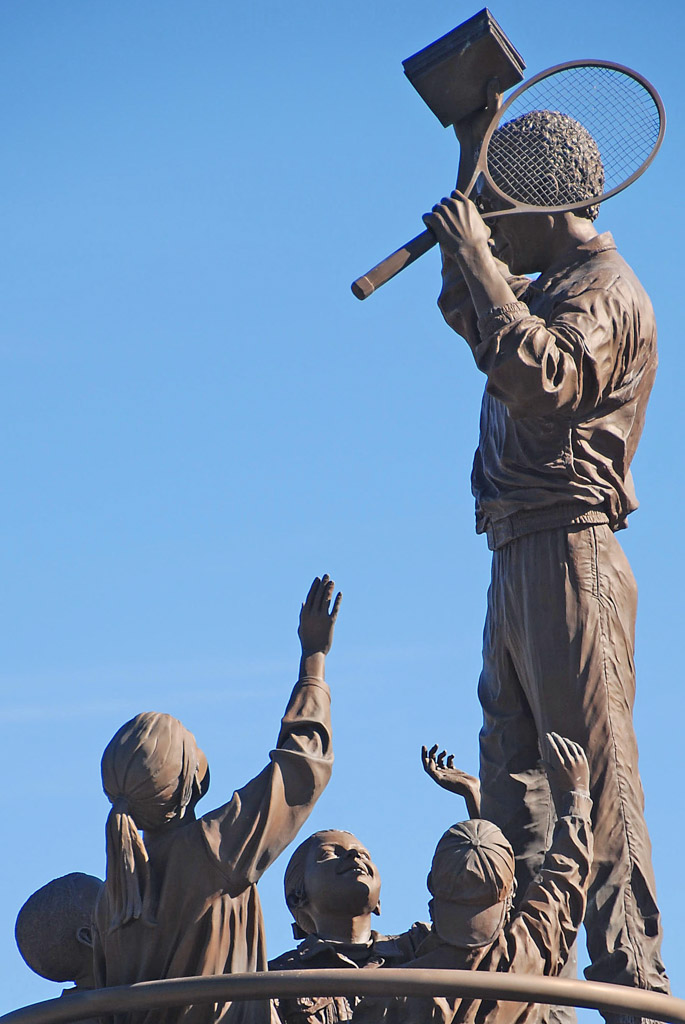
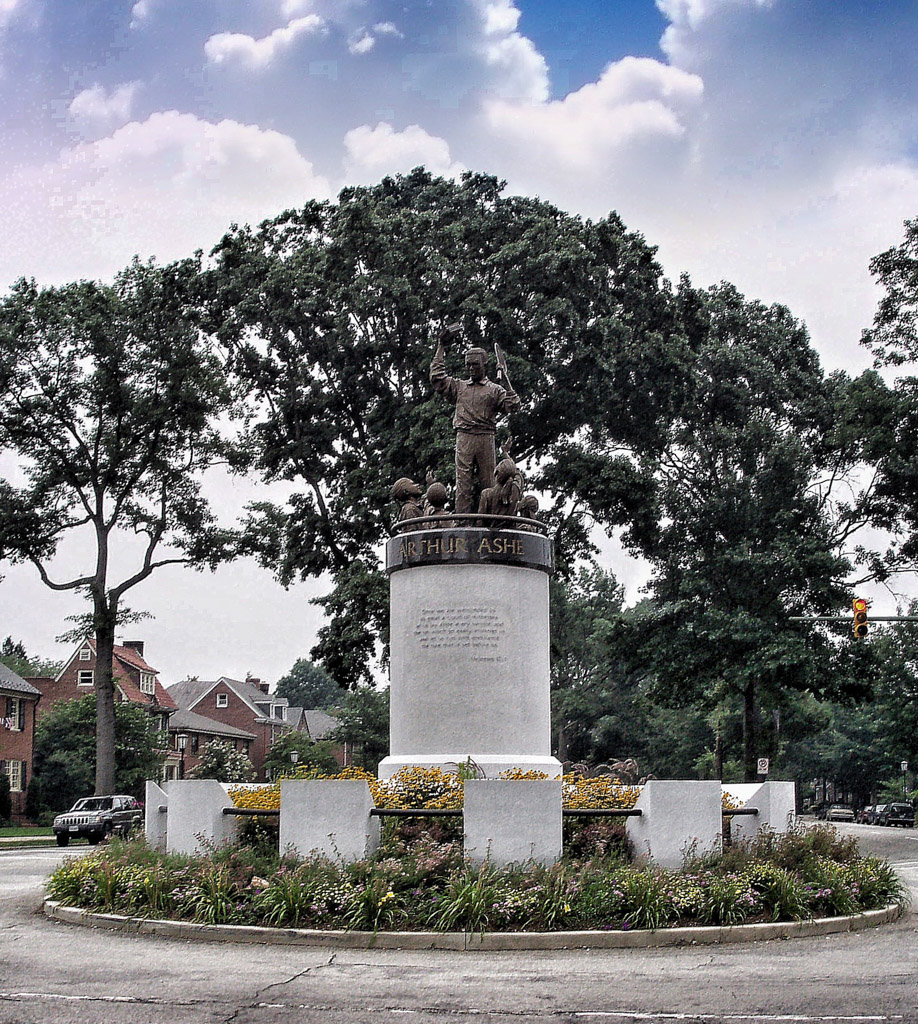
This westernmost monument on the Avenue depicts Arthur Ashe, the legendary tennis player and Richmond native, who was the first African American man to win the U.S. Open and Wimbledon. His statue faces west from the intersection at Roseneath Road and he is depicted, according to his wishes, as he appeared towards the end of his life, emaciated from his struggle with AIDS, but still sharing his love of sport and knowledge. Ashe holds aloft a tennis racket in one hand and books in the other, while four children reach up to him from below. When local artist Paul DiPasquale approached Ashe about sculpting him, Ashe himself suggested this composition as an appropriate way to commemorate his legacy of youth empowerment through tennis and education. Though the statue’s quality and composition were much discussed, its location generated the biggest controversy. When DiPasquale finished the statue after Ashe’s death in 1993, it had no predetermined location, but many public officials endorsed a site on Monument Avenue. While some regarded the placement of a statue of a prominent African American amidst those memorializing the Confederacy as a symbol of racial progress, others viewed it as disrespectful to Ashe’s memory that his statue would be sharing public space with racist traitors. At the opposite extreme was the white supremacist argument that it was the monuments to Lee and others that would be disrespected by the presence of Ashe’s statue. The City Council gave final approval in 1995 and the statue was installed in 1996. In the ensuing years, many Richmonders credited the addition of the Ashe Monument as significantly altering the perception of Monument Avenue, turning what former Virginia Governor L. Douglas Wilder called “the living room of the city” into a more inclusive public space. Following the anti-racism protests in 2020, the Ashe Monument remains the only statue on Monument Avenue that is not slated for removal.
Arthur Ashe Monument
1993–1996, Paul DiPasquale, sculptor; Barry Starke, base. Intersection of Roseneath Rd. and Monument Ave.