

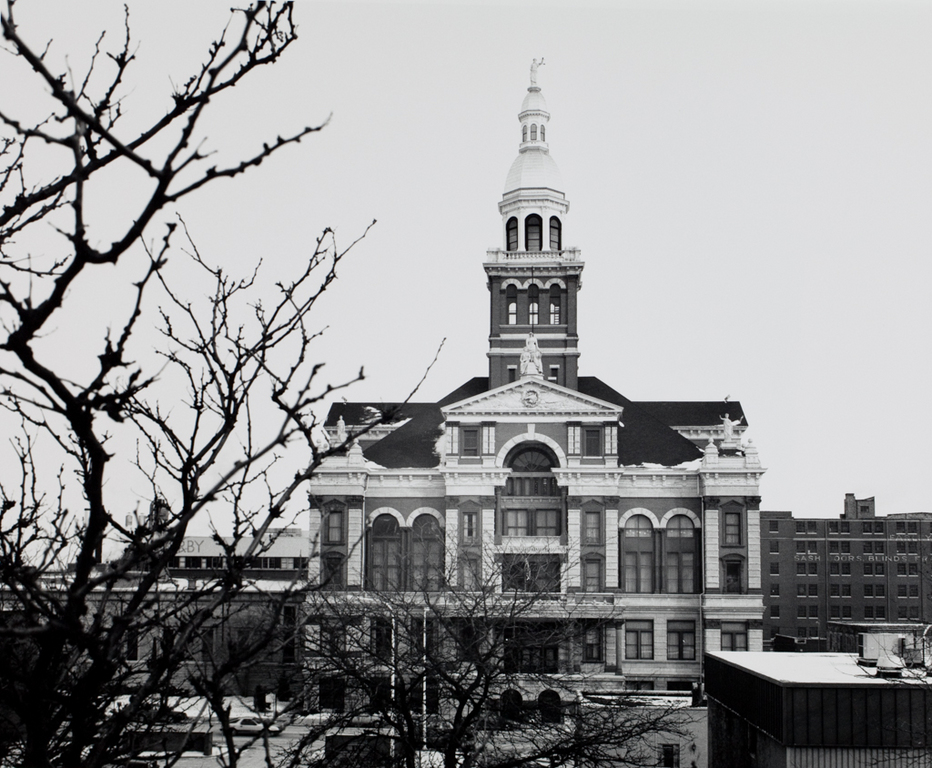
As with many Iowa municipal buildings, the first courthouse in Dubuque was a two-story log structure, built in 1836. Three years later a brick courthouse was erected. It was a two-story building with a gable roof, essentially Greek Revival in imagery. In 1857 the architect John F. Rague added three more bays to the front of the building. He also added a few touches to its gabled front—a deep two-story arched entrance, and Gothic hoods for the windows to the side. Considering the city's size and aspirations, it is surprising that it was as late as 1891 before a new, really proper courthouse was built. This was designed by the Swiss architect Fridolin J. Heer and his son, Fridolin Heer, Jr. The older Heer came to the United States in 1864, and the following year set up an office in Dubuque. His son studied architecture in Germany and later worked in Chicago in the Adler and Sullivan office. Though the 1891 courthouse is indeed Beaux-Arts in its detailing, it reads as a “Victorian” building rather than as an example of the “new” French Classicism. The reasons for this have to do with its vertical massing, the relationship of individual details to one another, and the strong contrast between dark brick walls and light limestone trim. The design entails a two-story basement section surmounted by a two-story section of piers, pilasters, and intertwined arches. Above the entrance porch, drawing dramatic attention to the principal facade, is a deep arch that reaches into a pedimented attic. When built, the central tower rose into a segmented dome, and below on each of the corners was a large-scale figure. The dome was removed, as were the figures, and the tower now has a tall narrow lantern. In 1932, as part of John Nolen's City Beautiful civic center for Dubuque, it was proposed that the building be demolished. Fortunately (for the building) the depression intervened, and it was left standing and in use. In the early 1970s, it was restored and its dome was gilded.
Dubuque County Courthouse
 David Gebhard and Gerald Mansheim
Dubuque County Courthouse
1891–1893, Fridolin J. Heer and Son. 720 Central, northeast corner with 7th St.