

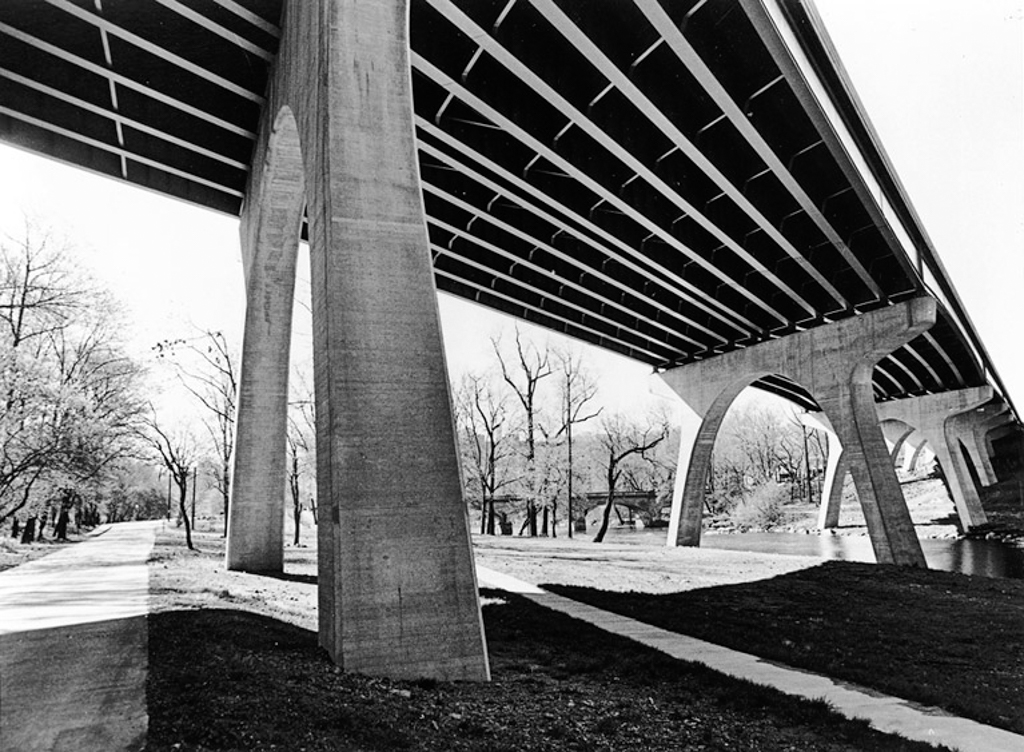
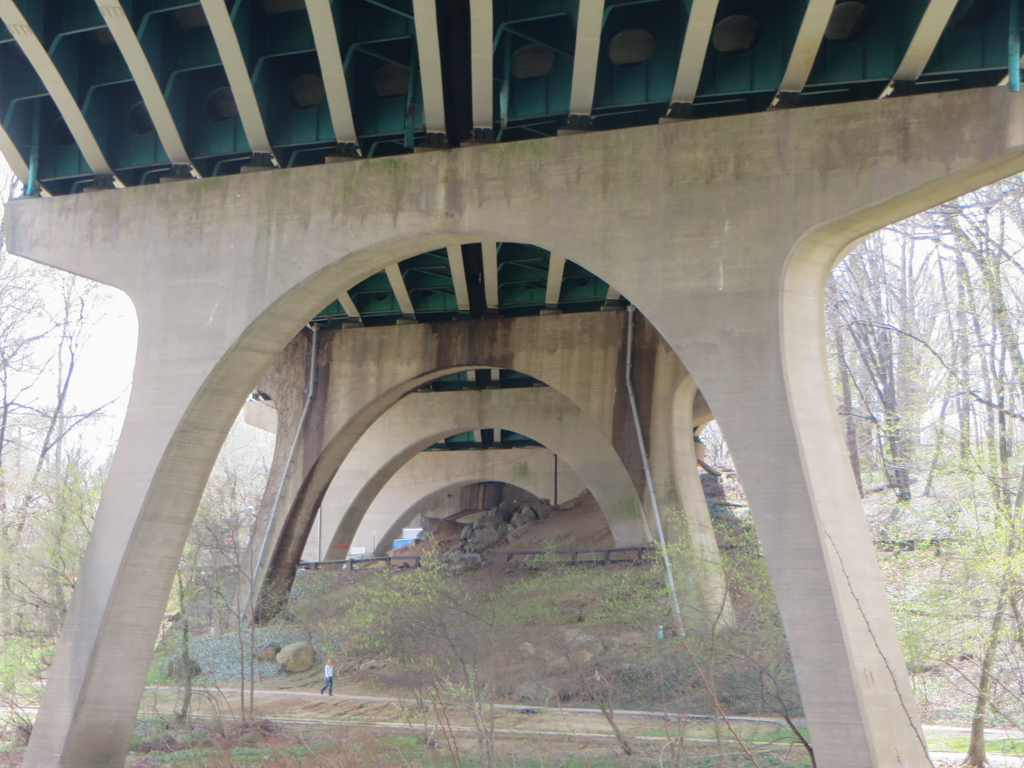
This massive bridge over the gorge-like valley of the Brandywine epitomizes the challenges inherent in constructing I-95 through northern Delaware, the last gap in the planners' dream of driving from Washington to Boston without stopping. It was a dramatic and controversial process. The first section of I-95, then known as the Delaware Turnpike, was dedicated at the Maryland-Delaware line in 1963 (see
PR1
). Extension of the road through Wilmington to Pennsylvania was completed in 1968. As historian Carol Hoffecker has described (1983), President Dwight Eisenhower's Commissioner of the Bureau of Public Roads, Francis V. du Pont, pushed for a highway directly through the city rather than around its eastern edge, although this involved wiping out a series of city blocks between Adams and Jackson streets—destroying 652 homes and dislocating 926 families. Among the public buildings lost were the brick and terra-cotta Willard Hall School (1884–1886, Edward Luff Rice Jr.; demolished 1962). The 1,870-foot bridge over the Brandywine, designed by the firm that built the Delaware Memorial Bridge (NC3), won an award from the American Institute for Steel Construction. The bridge's most dramatic aspect is the leglike, sculptural concrete piers that support the steel superstructure of twelve plate girders, each eight feet deep. The concrete deck has been replaced twice (1978–1982, again in 2003).
I-95 Bridge
1963–1967, Howard, Needles, Tammen and Bergendoff, engineers. Over Brandywine Creek