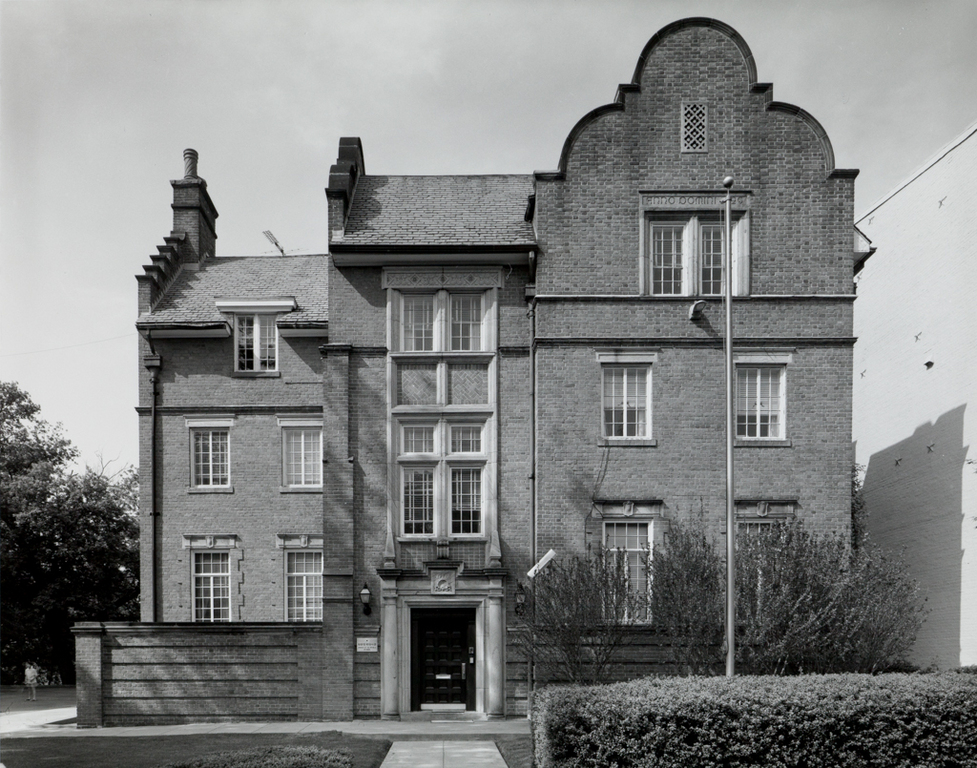
Enclaves of late Arts and Crafts houses inspired by English Neo-Tudor architecture dating from the 1920s and 1930s are rare within the city boundaries. Few examples are as beautifully designed or sited as the Stanley residence. Originally set within a miniature English garden, it has a picturesque composition of offset and intersecting masses culminating in curved and stepped gables with unusual silhouettes that are uninterrupted by competing structures. An unfortunate rear addition destroys its three-dimensional beauty. The rosy-hued brick sheathing creates a richly toned surface, the texture of which is enhanced by patterned fields of brick, and both Flemish bond (in the front gable) and English bond (the remaining wall surfaces). Although its stylistic heritage is at odds with the predominant architecture of the area, the Stanley House's composition, dependent on local symmetries (seen in the double-bay front gable) and controlled asymmetries (as in the three-bay main facade), is found on many neighbors with designs derived from high-style continental architecture.


 Franz Jantzen