

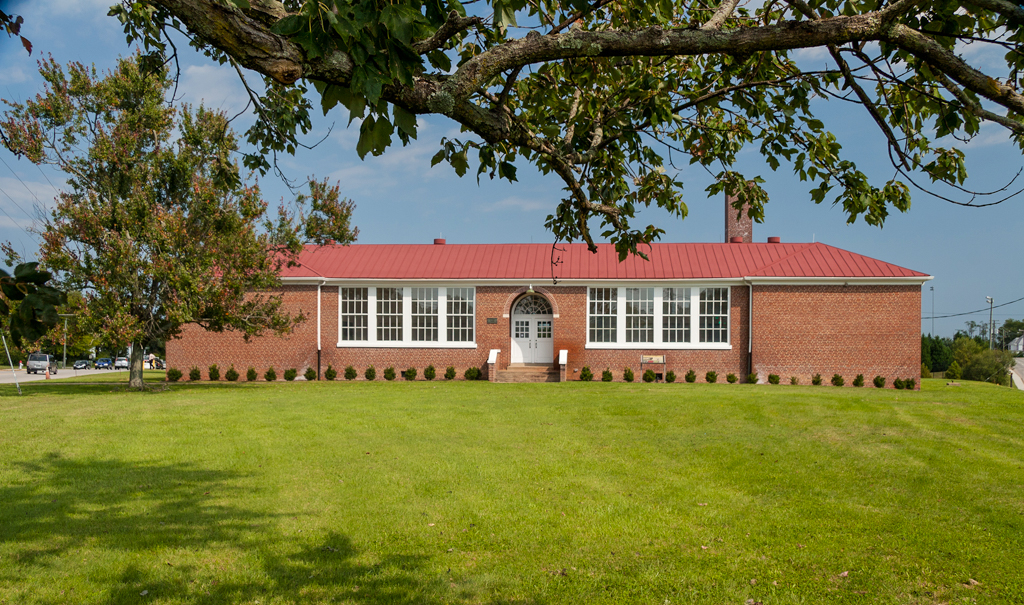
Farmville's one building of national importance is an unprepossessing landmark, a modest structure on the principal street of African American houses and businesses. This, the first building constructed for the secondary education of African American children in Prince Edward County, was named for Robert Russa Moton, a Prince Edward native (see
PE14
) who succeeded Booker T. Washington as president at Tuskegee Institute. The school was the scene of an opening chapter in the civil rights movement. On April 23, 1951, Barbara R. Johns led fellow students in a strike to protest insufficient funding and crowded conditions in the facility, including classrooms in temporary wooden buildings behind the single-story brick school. Moton was conspicuously smaller than Farmville High School, built for whites in 1937, despite comparable populations of school-age children. Johns was influenced by seminal thinking on racial equality by Vernon Johns, another Prince Edward native and Martin Luther King Jr.'s predecessor at Ebenezer Baptist Church in Atlanta. The strike resulted in Thurgood Marshall and the NAACP including Prince Edward County in the case for racial integration in U.S. public schools, ultimately heard by the Supreme Court as Brown v. Board of Education.
The one-story U-shaped brick building has a recessed arched entrance flanked by groups of four large windows, in turn framed by slightly projecting brick end pavilions. The building contains four classrooms in the front section, an auditorium in the center, and two classrooms and a restroom in each rear wing. The building is now an outstanding museum dedicated to the history and preservation of civil rights.