

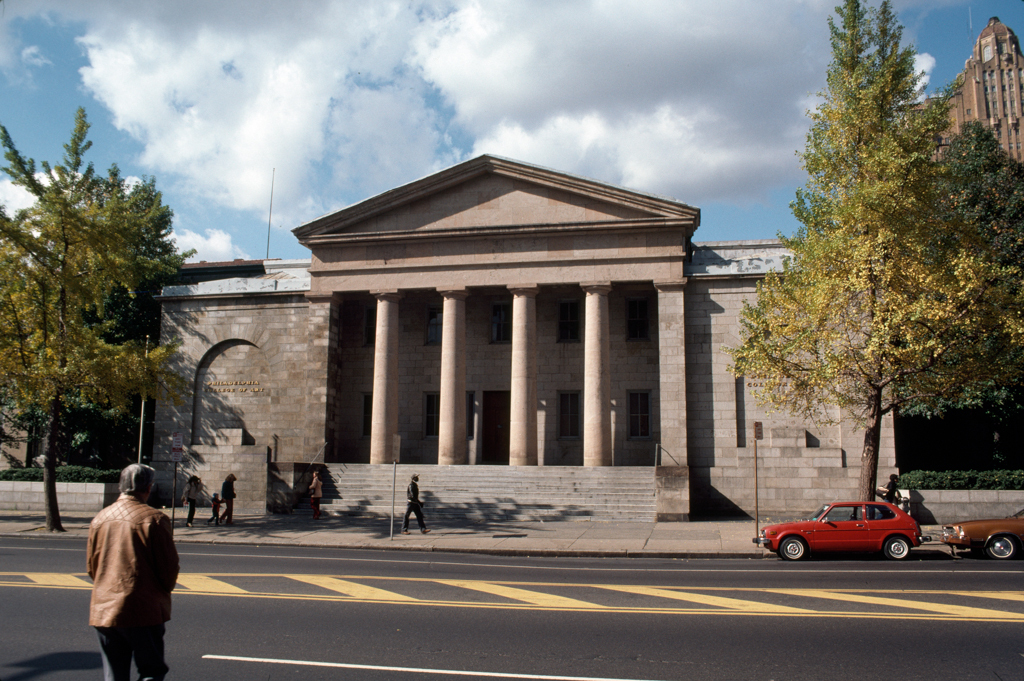
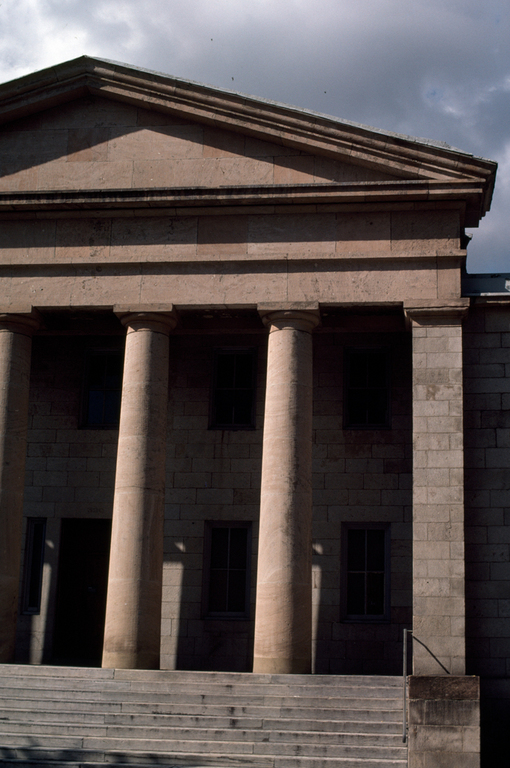
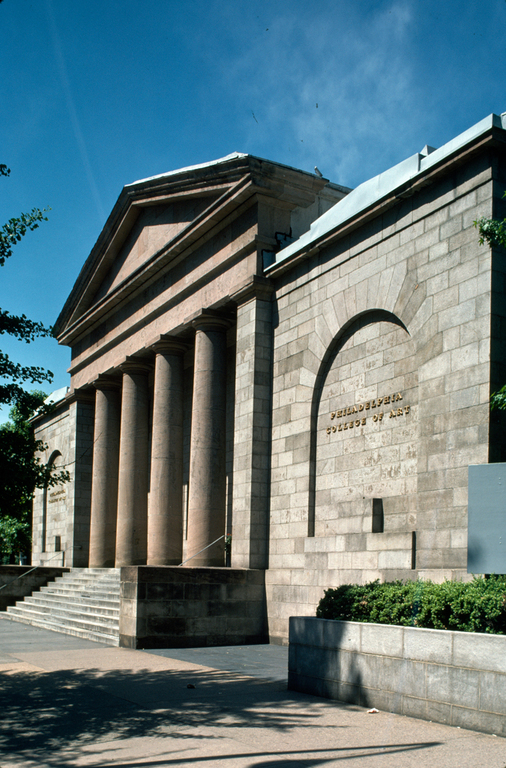
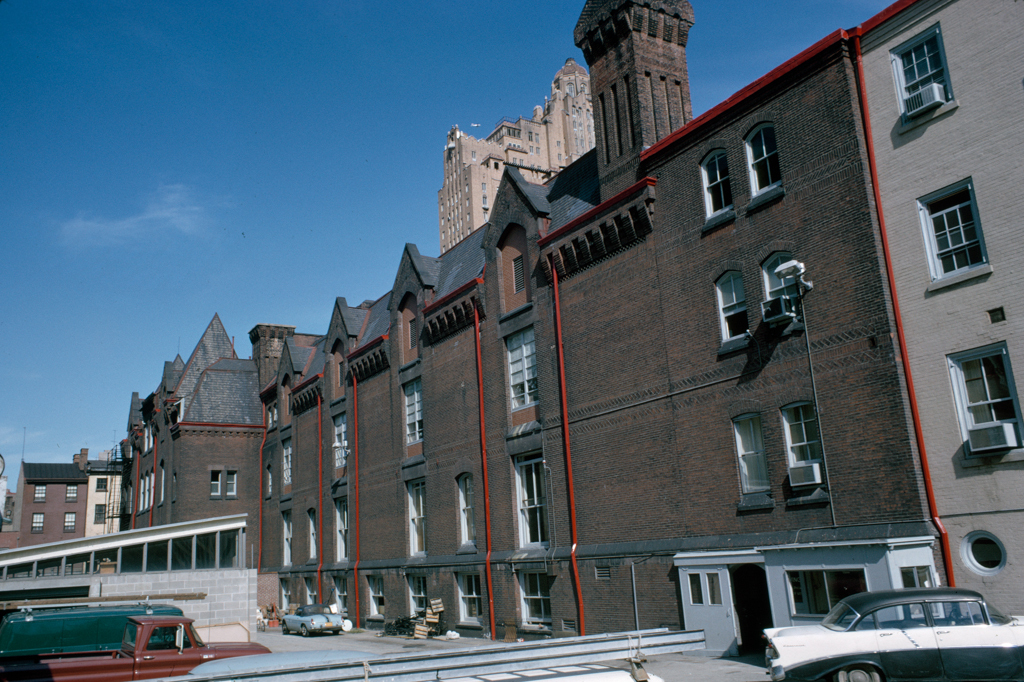
The central building of the University of the Arts is a spare essay in neoclassicism. Evidencing the rise of artistic personality, Haviland's primal geometry typically contrasts with the delicacy of William Strickland's work. Here, Haviland used a deliberately archaic manner with unfluted Doric columns carrying a muscular entablature of Egyptian character. The blind niches in the flanking wings were to be ornamented with symbols of the new sign language that connected the deaf to the wider world. The brick rear wings, added by Furness and Hewitt, adopt an industrial vocabulary to spaces intended to provide training in the skills needed for Philadelphia's industrial workforce. Massive chimneys, now shorn of their phallic tops, allude to industry while large windows, placed where they are needed, contrast Furness's functional logic with Haviland's historical forms. In 1893, with the departure of the school to a suburban setting in Mount Airy, the building was adapted to serve as the Pennsylvania Museum and School of Industrial Art, an offshoot of the Centennial Exhibition intended to train Philadelphia workers and artisans in crafts that would enhance the city's manufacturing base. Among its students were such architects as Edgar V. Seeler and William L. Price.
University of the Arts (Pennsylvania Institute for the Deaf and Dumb)
1824, John Haviland; 1874–1875 rear wings, Furness and Hewitt; 1983 renovated, F. Daniel Cathers and Associates. 320 S. Broad St.