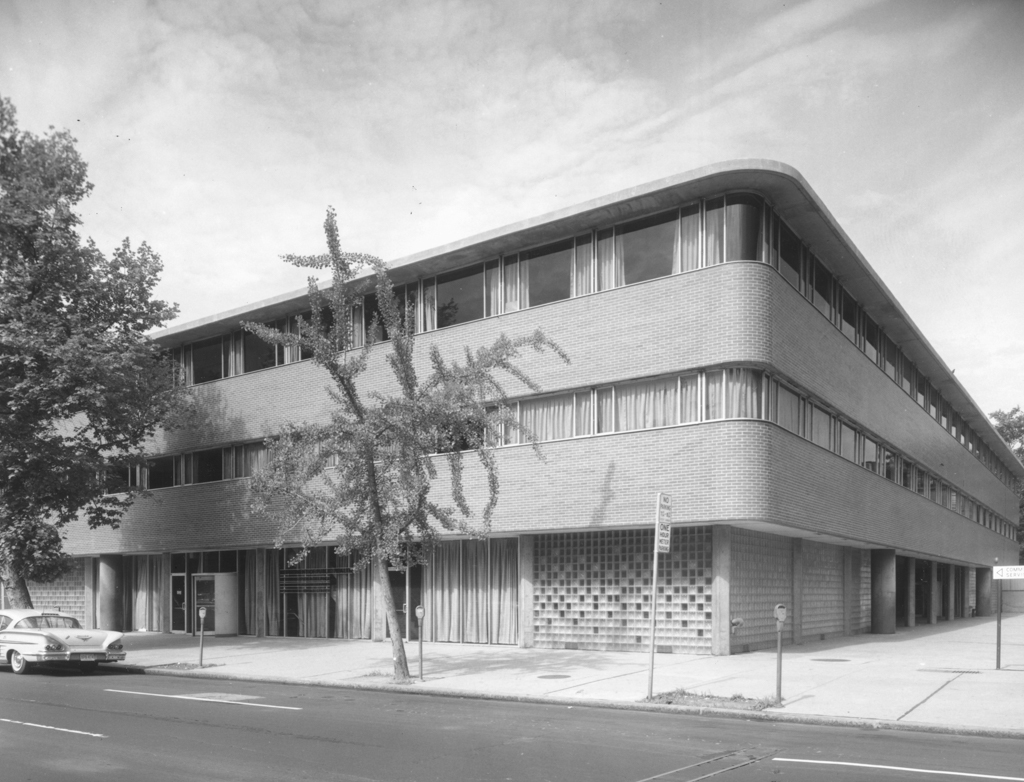
Among the rare modern buildings of consequence from the iconoclastic 1950s in Philadelphia is this round-cornered, bluetile-clad surprise. Adhering to Henry-Russell Hitchcock's and Philip Johnson's principles (enumerated in their book The International Style, 1932) that modern architecture is an affair of volumes rather than mass, asymmetry rather than symmetry, and materiality rather than ornament, architects Montgomery and Bishop floated the tile-clad second story above the first floor on stainless steel–clad pilotis and spanned the giant atrium of the interior with a trussed roof. These forms describe the plan, an open first floor and offices on the periphery of the second level looking into the open central atrium that perhaps recalls Frank Lloyd Wright's Larkin Building. The exterior, by contrast, is rooted more in the contemporary work of Morris Lapidus than Bishop's training in Wright's office. The site is of importance as the location of Furness's Bloomfield Moore House (1871–1873), which Louis Sullivan memorably described in his Autobiography of an Idea (1924) as “a flower by the roadside.”

