

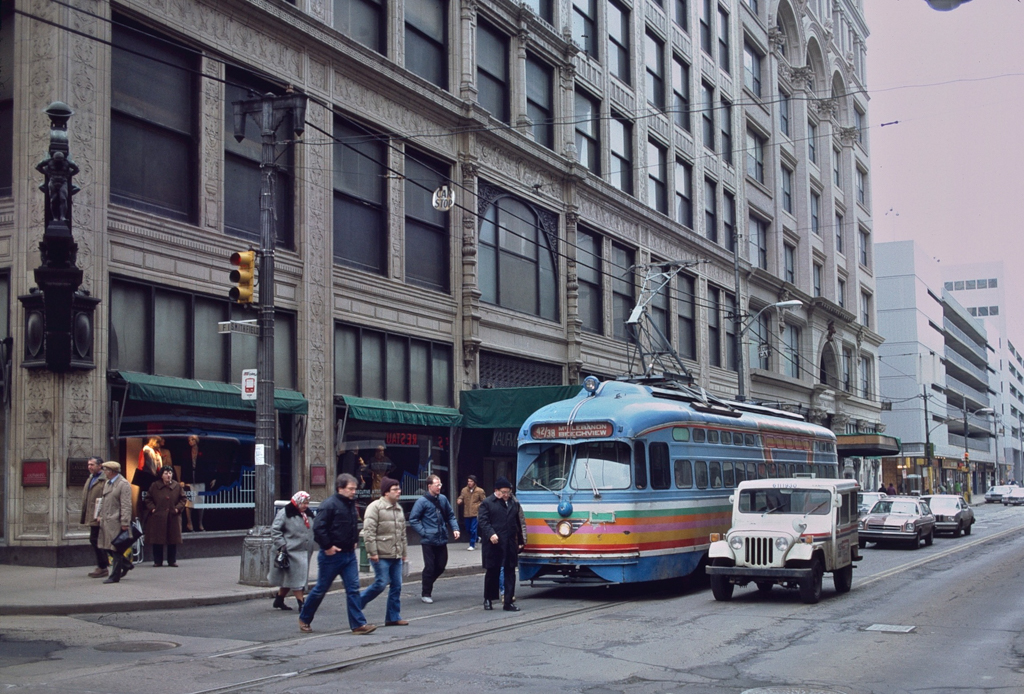
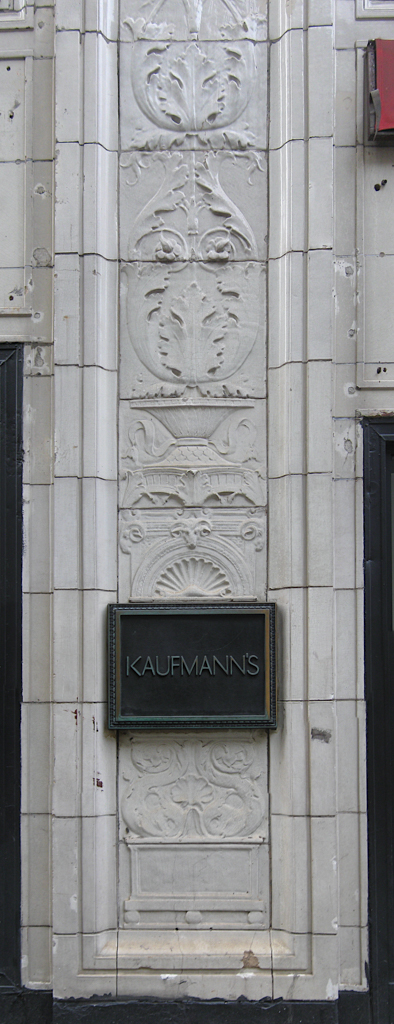
Opened in 1871 as a tailoring shop on the South Side by four immigrant brothers who had graduated from peddling, Kaufmann's Department Store found itself by 1885 at the best corner downtown, Smithfield Street and 5th Avenue, where it erected a replica of the Statue of Liberty. The building that stands now as the south half of the block-long Macy's store (since 2007), at Smithfield and Forbes Avenue, is a wing added in 1898 that combines Classical Revival, Romanesque Revival, and Chicago School motifs. In 1913, Edgar Kaufmann, of the second generation, tore down the original 1885 store on the north half of the block and commissioned its replacement: this delicate thirteen-story, white terra-cotta extension from Benno Janssen. In those same years, the store began leasing the wooded property southeast of Pittsburgh that would later host Kaufmann's weekend house, Fallingwater.
Kaufmann's brilliance as a retailer derived in large part from his commercial exploitation of architectural and technical innovation. Janssen and Cocken's ground floor redecoration of the store in 1930 (Kaufmann had demurred on a more radical Art Deco remake from New York's Joseph Urban) used