

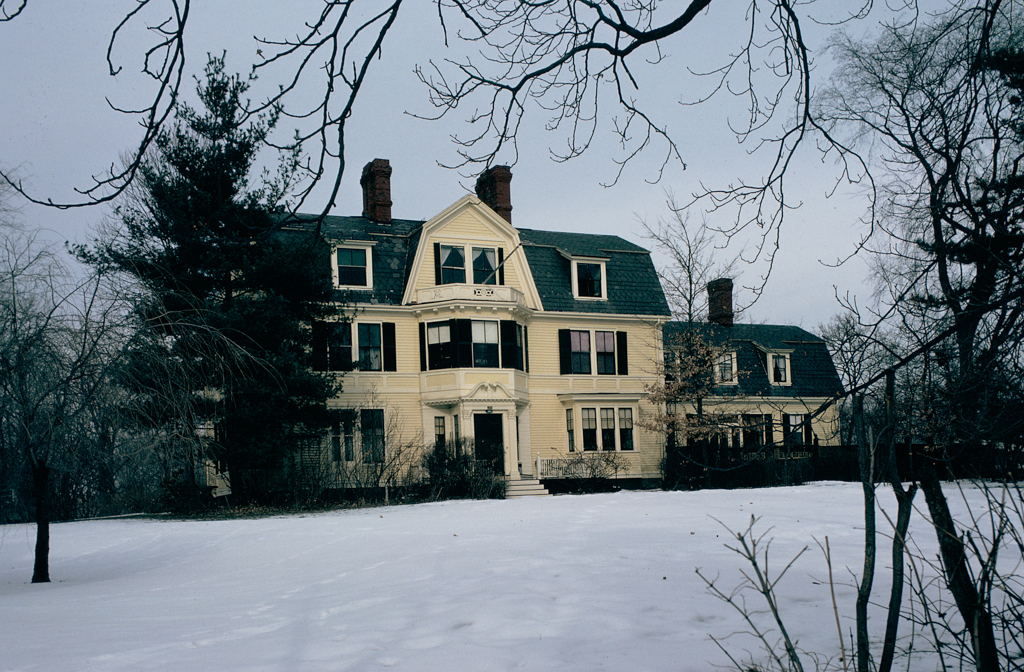
Like the nearby Arthur Astor Carey House (BS19) by the same firm, the Hooper-Eliot House is an exceptionally early exercise in the renewed use of colonial forms. The gambrel roof and the symmetrically balanced entrance (originally garden) facade show John Sturgis's continued attraction to colonial forms. One of the important early women architects in the Boston area, Lois Lilley Howe added the broken scroll–pedimented doorway when the entrance to the house was transferred to the south side. Samuel A. Eliot, minister of Arlington Street Church (BB2) and president of the American Unitarian Association, purchased the house in 1902; his son, landscape architect and city planner Charles W. Eliot II, subsequently lived here. In a common pattern of real estate development for this neighborhood, architect Kenneth Redmond erected his flat-roofed clapboard and glass residence at 11 Reservoir Street in 1965, overlooking the large south lawn of the Hooper-Eliot House.
Hooper-Eliot House
 Keith Morgan
Hooper-Eliot House (NR)
1872, Sturgis and Brigham; 1902, Lois Lilley Howe. 25 Reservoir St.