

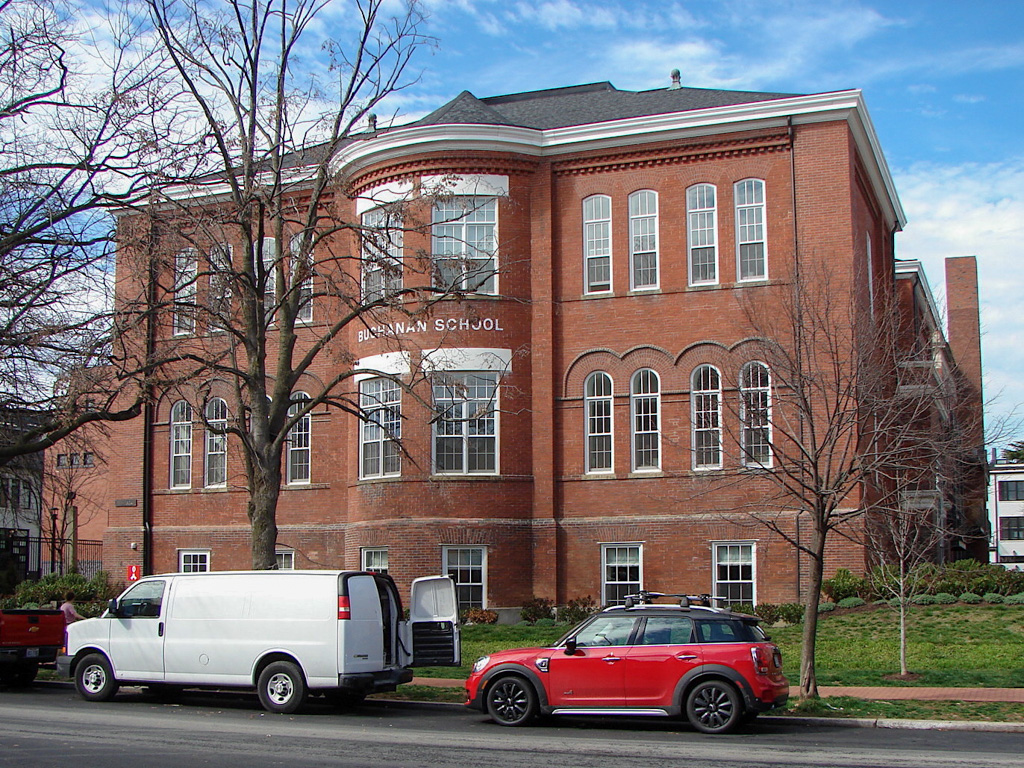
The James Buchanan School was one of the last public school buildings the Office of the
Many of the red brick schoolhouses of the 1880s and 1890s employed common design features. The Buchanan School was an exception to the common pattern. Its bowed central pavilion creates a towerlike effect, accentuated by a conical roof and a flagpole at the top. The heavy stone lintels give the two double windows in the bow a distinct prominence. The flanking pavilions, measuring two bays each, are made up of double round-arch windows on the first floor and double segmental-arch windows at the second floor. The side entrances are notable for the large, circular-arch entrances; each arch springs from elaborately carved imposts.
To the east of the Buchanan School and its later additions is the Buchanan School playground, a highly sculptural array of concrete, wood, and brick forms intended to serve as a new “play plaza.” Inspired by First Lady Mrs. Lyndon B. Johnson's interest in “beautification,” Mrs. Vincent Astor of New York City hired architect Simon Breines and landscape architect M. Paul Friedberg, both of New York City, to create an innovative recreational area for Capitol Hill children. The park was conceived in 1966 and constructed in early 1968, just before the riots that accompanied the assassination of Martin Luther King, Jr., swept through the city. At the time of the park's completion, this section of Capitol Hill was viewed as possessing dispiriting ghetto conditions. The playground was “aimed directly at the relief of human despair.”