

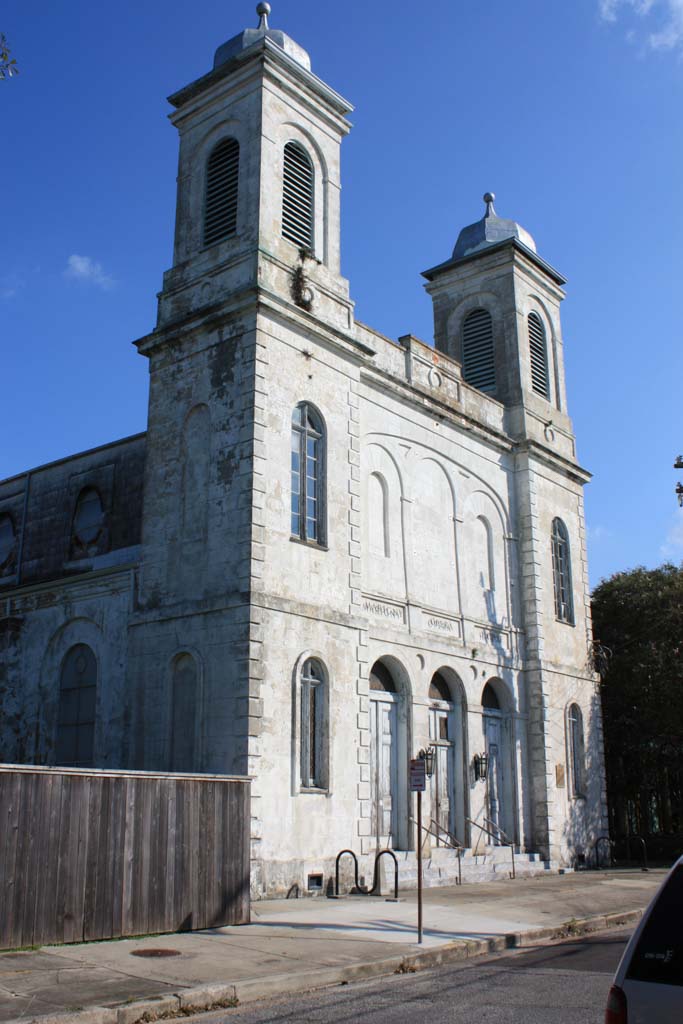
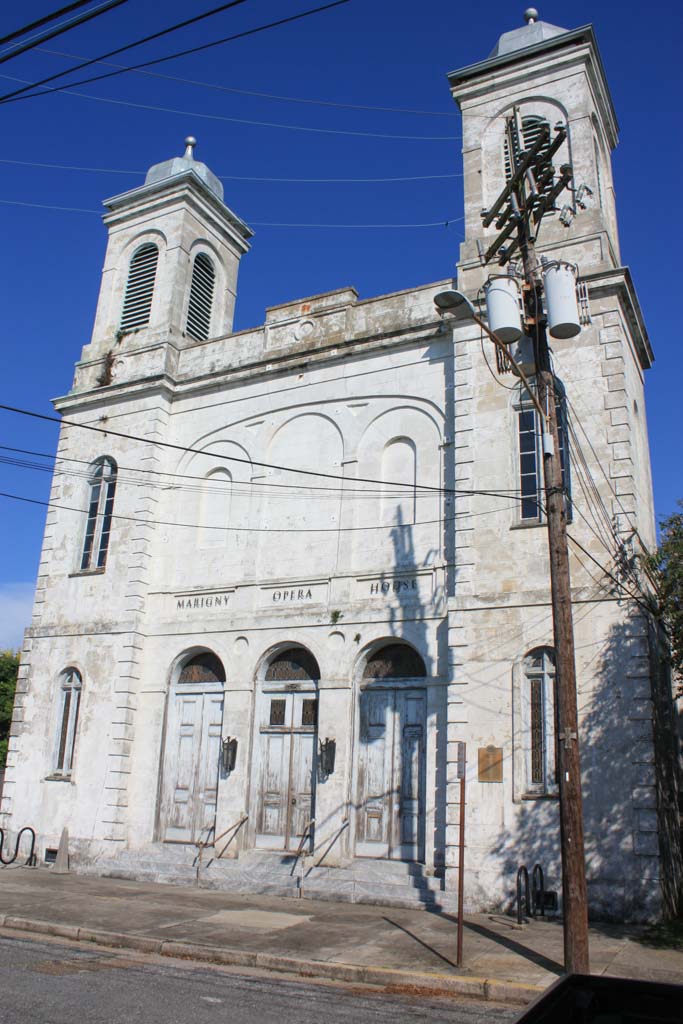
In the 1840s, the growing number of immigrants who came to New Orleans tended to settle in neighborhoods by ethnic group and establish their own churches, where services were conducted in their native languages. Holy Trinity was one of the churches established for German Catholic immigrants in this part of Marigny, once popularly known as Little Saxony. Twin bell towers with small segmental, onion-shaped domes mark the corners of the plain plastered brick facade, which is scored to imitate stone. Entrances and windows are round-arched, and elliptical clerestory windows line the upper side walls. Inside the
church, slender box columns support the barrel vault. Closed in 1997 because of dwindling attendance, the church was afterwards deconsecrated and, in 2011, converted for use as an arts and performance venue. The sixteen rare French stained glass windows dating from the 1880s were removed by the archdiocese for installation elsewhere. Theodore E. Giraud (c. 1821–1864) came to New Orleans from Galveston in the late 1840s, where he designed several churches (most since demolished) in New Orleans and southern Louisiana before departing for Monterrey, Mexico, where he died.
Marigny Opera House (Holy Trinity Church)
1853, Theodore E. Giraud. 714 St. Ferdinand St.