

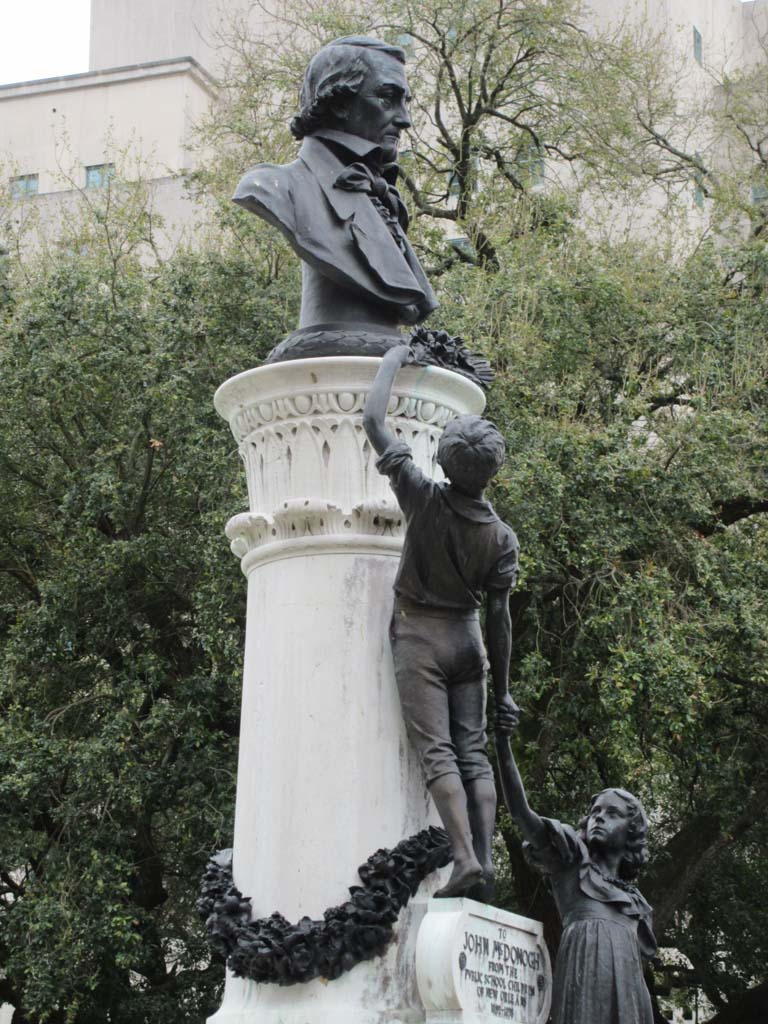
Originally named Place Gravier, the square was renamed for the Marquis de Lafayette in 1824, following his visit to New Orleans during his triumphal 1824–1825 visit to the United States. The square, formerly fenced like Washington and Jackson squares, served as the public open space for Anglo-Americans, their equivalent of the Creoles’ Place d’Armes (now Jackson Square). It also became a focus for commemorative statues, among them Joel T. Hart’s bronze statue of Henry Clay (1860), a bronze of Benjamin Franklin (1926), and Attilio Piccirilli’s sentimental bronze (1898) of two children reaching up to a bust of John McDonogh (1780–1850), commemorating his 1850 bequest of $750,000 to the public school system of New Orleans (he gave a like amount to Baltimore). Attilio immigrated to the United States with his father and five brothers in 1880. All were sculptors/marble cutters, and the brothers carved the Lincoln Memorial in Washington, D.C., under the direction of Daniel Chester French. With Gallier Hall (formerly City Hall) on one side, the square became the site of political demonstrations and annual celebrations for school children honoring McDonogh. Today it is the site of public festivals and grandstands set up for carnival parades.
Lafayette Square
1788. Bounded by St. Charles Ave., and Camp and N. and S. Maestri sts.