

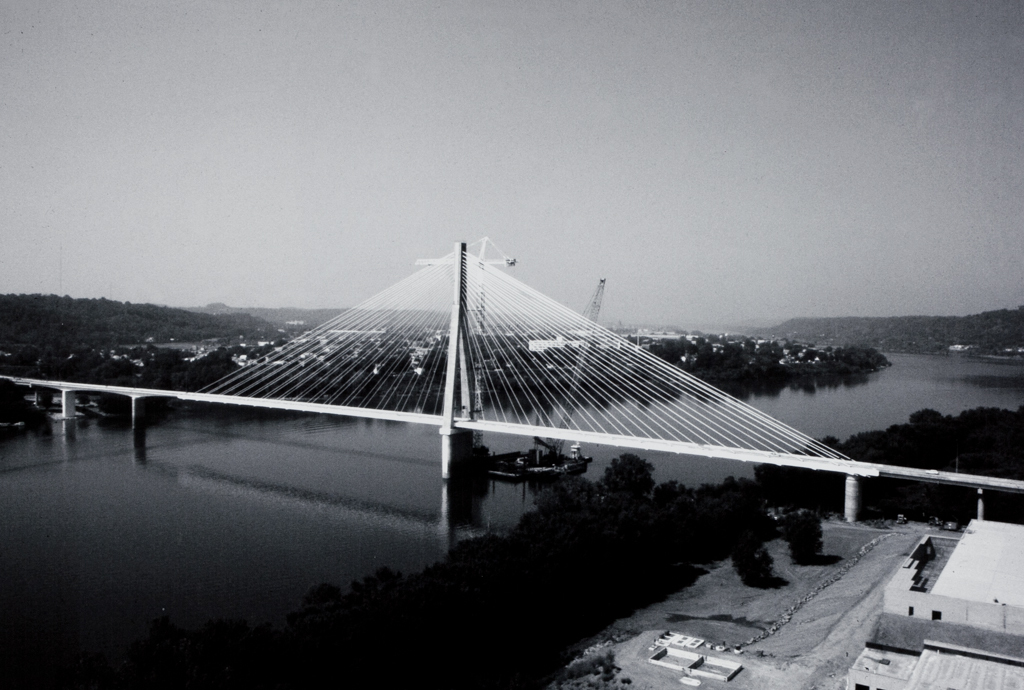
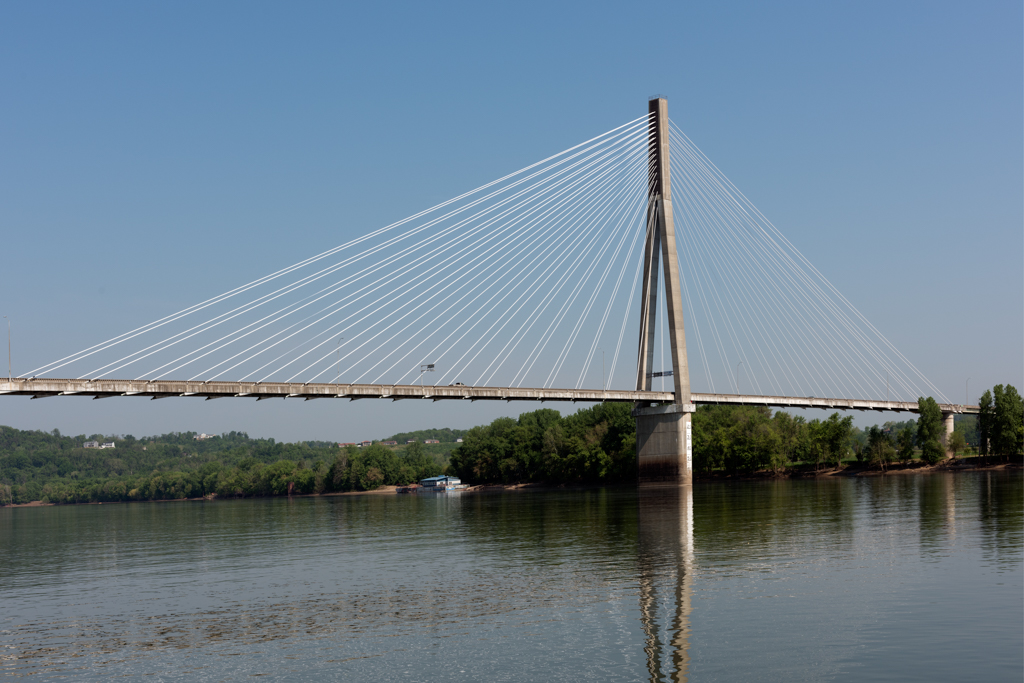
The dramatic yet graceful lines of this bridge, which has become something of an architectural symbol for Huntington, belie a complex, contentious history. It was planned in the late 1950s, and the state legislature authorized it in 1961. Controversies over its location, the possible effect on Guyandotte's historic resources and parklands, design considerations, and, of course, costs, all conspired to delay construction, which did not begin until 1974. Completed eleven years later at a cost of $38 million, the 2,841-foot bridge is a cable-stayed, concrete span with a single pylon that rises 370 feet. The striking silhouette of the tower with its suspension cables outlined against the sky provides an unforgettable impression.
Cable-stayed steel bridges were developed in Europe in the 1950s, and in the 1970s concrete was first used in place of steel. The first American bridge of this type, built in Washington state in 1978, received a Presidential Award for Design Excellence. The same Olympia firm that designed it also designed the East Huntington Bridge, the country's second example of the type, and the Weirton-Steubenville Bridge (see Brooke County). As described by a representative of the firm, the Huntington bridge is both slenderer and longer than its forerunner in Washington and utilizes concrete that can withstand extremely high pressure. Fittingly, when West Virginia Governor Arch A. Moore, Jr., dedicated the bridge in 1985, he rode across in a 1950s Thunderbird convertible, a subtle reference to the long time it took to plan and build. It was worth the wait.