

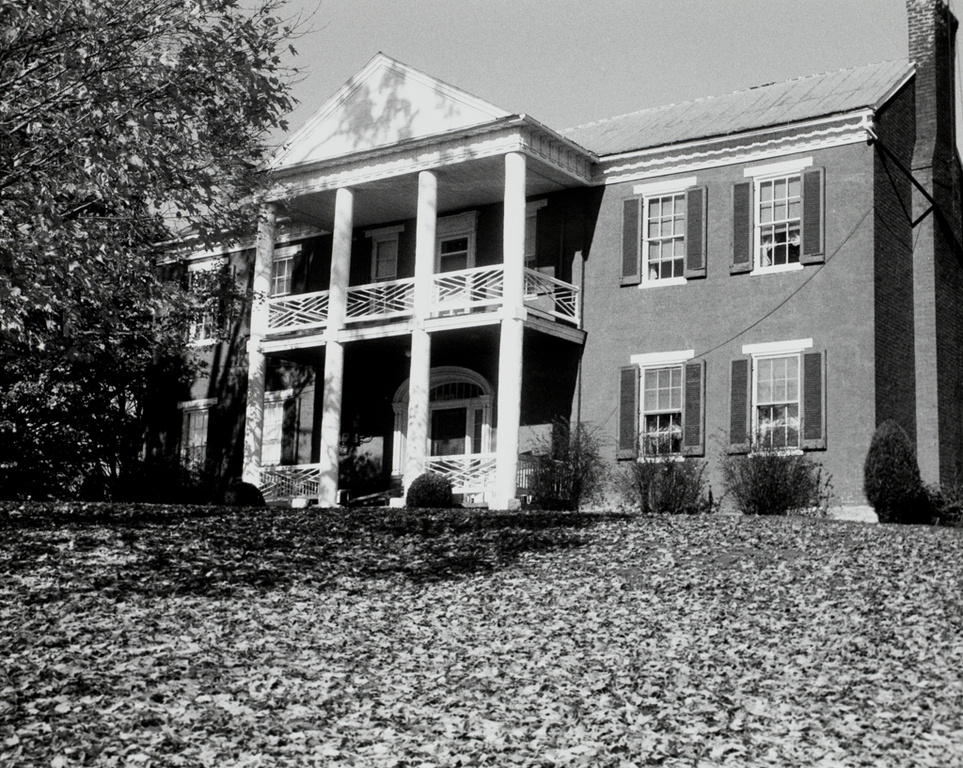
Perhaps the masterpiece of the talented team of Dunn (builder and brickmason) and Burgess (woodcarver extraordinaire), this imposing house illustrates the transition between the waning Federal and the emerging Greek Revival styles. A two-story pedimented portico with Chinese Chippendale railings on both levels imparts a decidedly Jeffersonian ambience. Unlike many contemporary Greenbrier houses of this caliber, which have only a distyle portico with simple architrave, here the arrangement is tetrastylar, and there is a full Doric entablature. The entablature is particularly elaborate, with metopes decorated with carved stars. The front doorway displays many of Burgess's signature elements: paired, reeded colonnettes, a fanlight with vertical muntins in place of the more usual spoke arrangement, and a row of small, carved wooden balls in the surround. Unadorned Greek Revival lintels contrast with these delicate Federal features. The plan is T-shaped, with three large rooms opening into a central stair hall on each floor. The dining room, behind the hall, is the most elaborately
Although Michael Baker built the house, Alexander Arbuckle bought it in 1835, and it continues in that family's ownership. Several early log and frame outbuildings stand in the yard.