

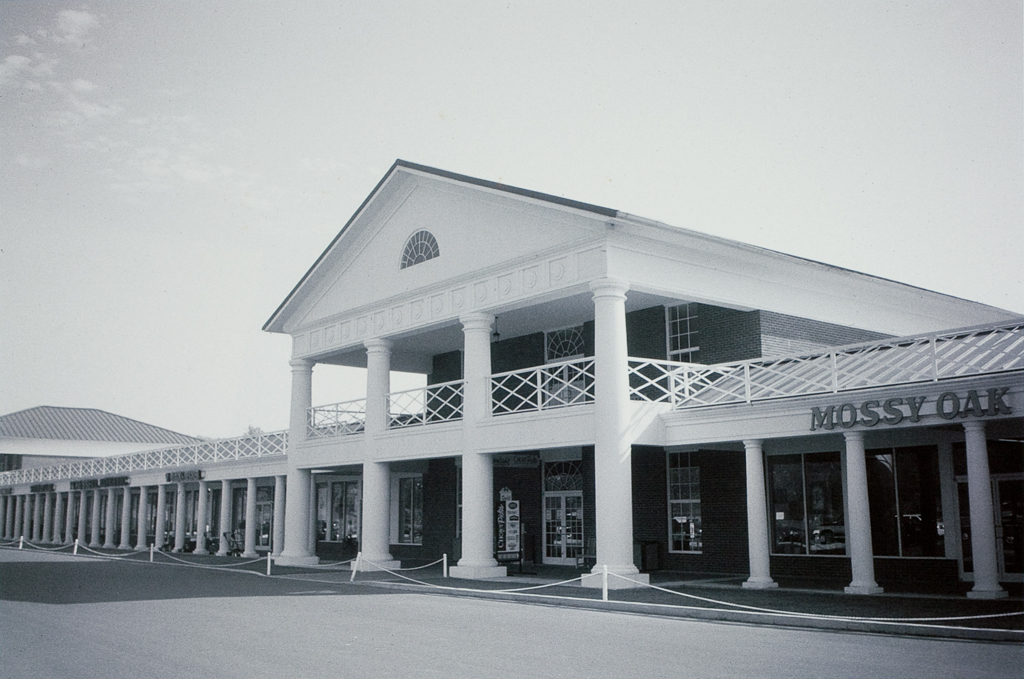
Most commercial enterprises—and their signage—at this interstate exit are typical of their type and could be found anywhere. One exception is this easily seen discount mall, its design all too clearly based on Thomas Jefferson's University of Virginia. Jefferson designed ten
At Flatwoods, only one side of the “Lawn” exists, and it consists of four, instead of five, twostory pavilions. Here the pavilions house anchor stores, while colonnades provide shelter in front of smaller specialty shops. At his university, Jefferson designed the pavilions to display different classical orders, intending them as models for architectural instruction, and embellished the entablatures with corresponding classical details. At Flatwoods, a single order—something akin to the Tuscan—prevails throughout, while names of stores, rather than garlands or metopes, appear on the friezes. In place of the Rotunda, another square-edged pavilion, larger than the others and standing at right angles to them, is the most recent addition to the complex. Whether or not a matching row of pavilions will be built will likely depend on whether Jefferson's plan works as well for this “commercial village” as it has for his “academical village.”