

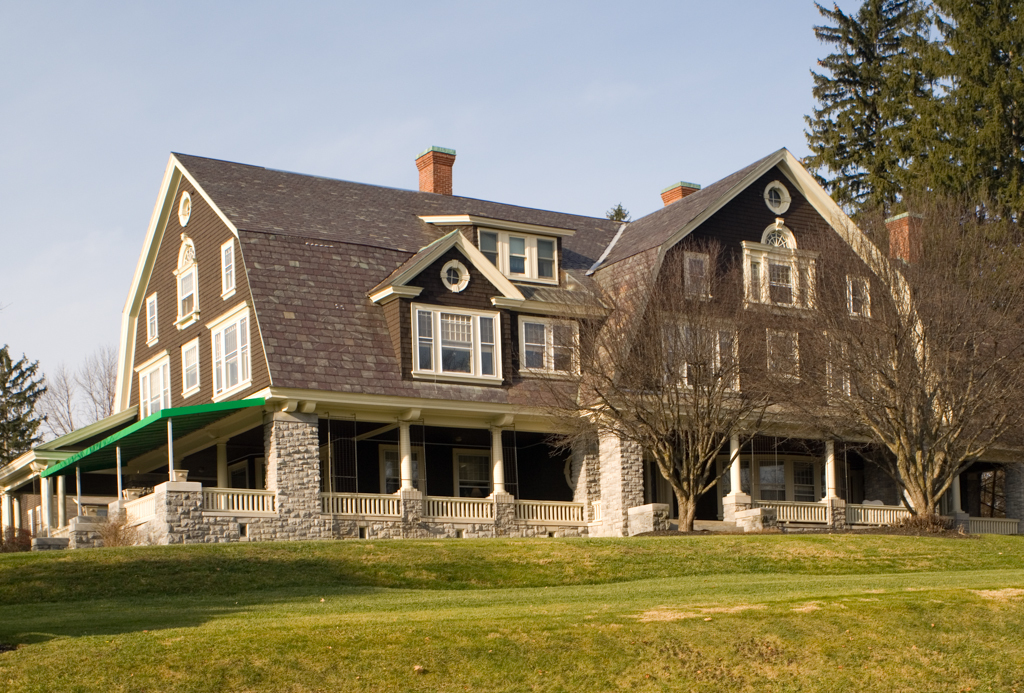
The Shingle Style house of International Paper Company director Herman Vaughan brought the imagery of grand coastal “cottages” to Grove Street. In scale it is a counterpart to the earlier mansions of Rutland magnates. The house has the expansive simplicity of late Shingle Style, purged of picturesque eccentricities under the influence of Colonial Revival. Arthur H. Smith had established a reputation for Tudor and Colonial Revival work with a fine sense of composition and detail. His unified scheme for the Vaughan house utilized a massive slate gambrel roof rising above a deep, shadowy, continuous veranda. Formed by powerful piers of rusticated gray marble interspersed with Doric columns, the veranda screens a recessed first floor animated by sheltered bay windows. Facade variety comes from a huge off-center cross gambrel and a mix of gabled and shed dormers. Fine details, indicative of the level of refinement of Colonial Revival in Rutland, are picked out in white against the dark wood shingles. Sash windows in a variety of sizes and clusters combine with the decorative accents of a third-floor Palladian window and keystoned bull's-eye gable windows. The whole conveys an air of substantial, quiet ease.
Linden Terrace (Herman Vaughan House)
1912, Arthur H. Smith. 191 Grove St., City of Rutland