

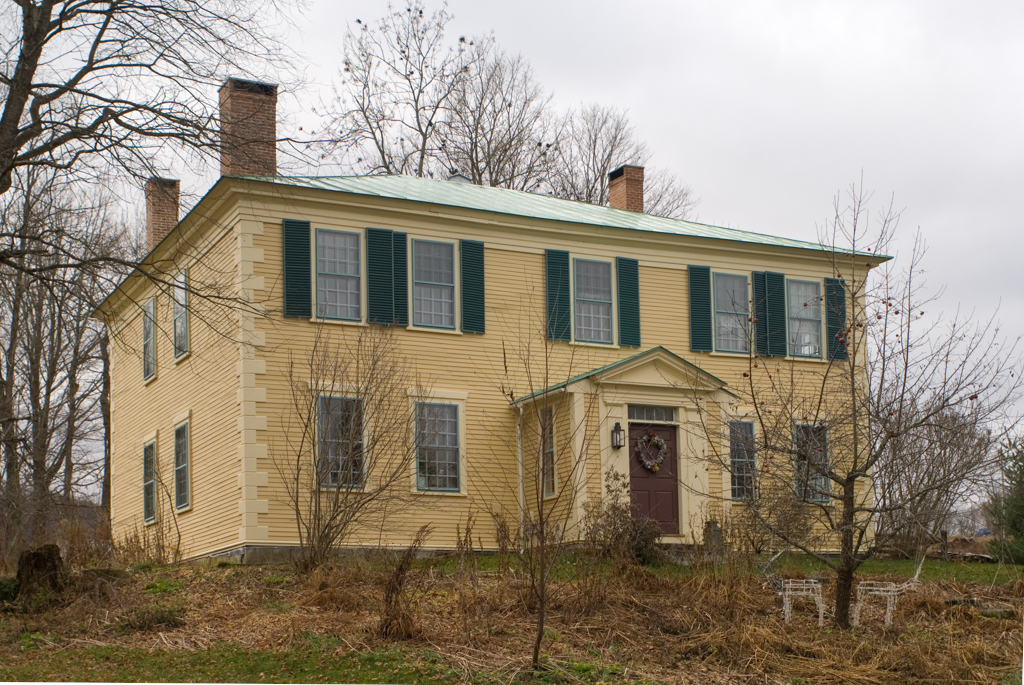
This house tells a tale of first-generation Vermont that has parallels in communities across the state. It reflects the success of Daniel Cooke—potash manufacturer, merchant, and innkeeper—who arrived penniless from Newton, Massachusetts, in 1788 and in little more than a decade became the wealthiest man in town. His house also reflects his roots, displaying features found in eastern and central Massachusetts, former home of Cooke and his fellow Orange County settlers, and that became typical for this part of Vermont. It continues late-eighteenth-century traditions with a Georgian plan, hipped roof, and massive end chimneys, two of which are still in place. Other Georgian details include the wood quoins that mark the corners, the trapezoidal lintel boards of the first-floor windows, the weighty cavetto cornice, and the surrounds of the transom doors. The door surround with plain tapering pilasters and closed pediment is a significant early Corinth type, and the cornice and unusual projecting entrances can be found in the Oxbow district of Newbury. Except for the loss of its original extensive western ell, the house looks much as it did when Cooke lived here and ran it as an inn.
Cooke House
c. 1800. Cookeville Rd. at Center Rd., Cookeville