

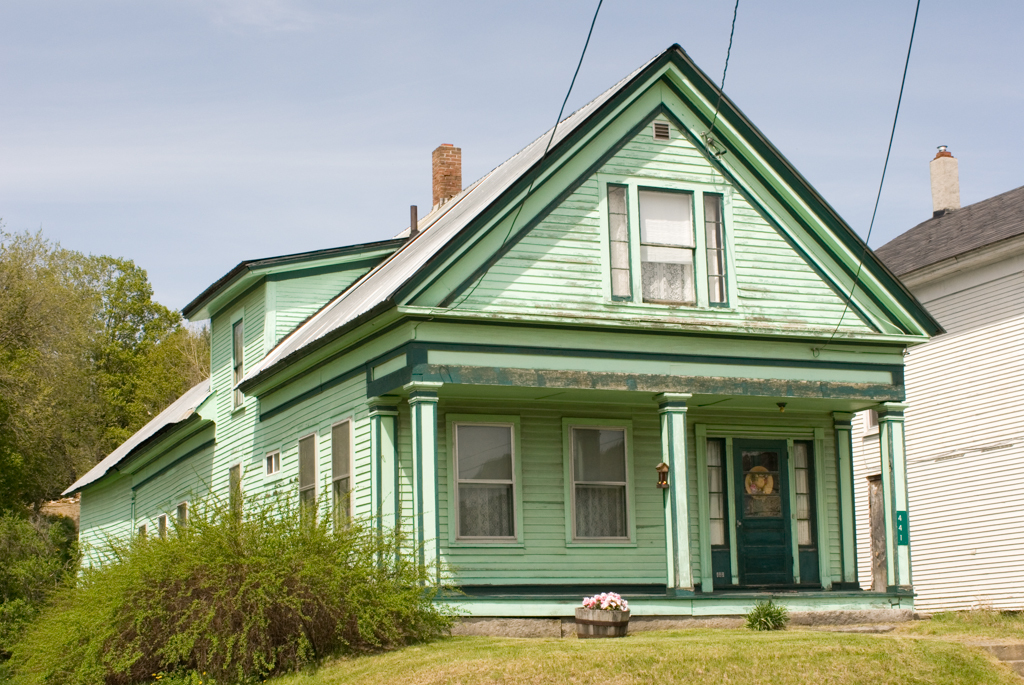
Beginning in 1837 West Concord village developed on the Moose River largely due to the efforts of mechanic and inventor John D. Chase. Chase built the first dam, saw- and gristmills, and house here and also invented a waterwheel and an early version of the circular saw. The mills, two carriage manufactories, and other industry soon made the village the commercial center of nearby towns, with seven retail stores operating in 1867. Among the several dozen village houses built during these years are vernacular designs representative of the evolving Greek Revival in lower Essex County. These are distinct from similar examples built elsewhere during the same period, for example St. Johnsbury Center and Passumpsic villages. In the village center on the north side of the main road (U.S. 2) are three wood-frame examples of the local version of the gable front with a recessed-columned porch design popular throughout much of eastern Vermont, but here the columns are square and paneled and carry an unusual paneled porch frieze. Although these details are replicated on a dozen other local examples, indicating at least a similar trim carpenter, the house types vary from five-bay fronts to four-bay “two-room” fronts and side-hall plans. Across the road to the west are two wood-frame Classic Cottage dwellings distinguished by three steep gabled wall dormers. A number of Classic Cottages in the area share one or two similar steep, front, wall dormers, as well as corner pilasters and a trabeated frontispiece with a heavy cornice. Emmons Stockwell, a carpenter, builder, and farmer, is perhaps responsible for the designs, given the similarity of twin, gabled, wall dormers and details with his house at the corner of Cross and Stockwell roads. Cephas Hall, who opened a carding mill in the village in 1871, is said to have built the triple-gable houses, along with several others in the village.
Concord Village Houses
c. 1870. U.S. 2, west of the green, West Concord village