

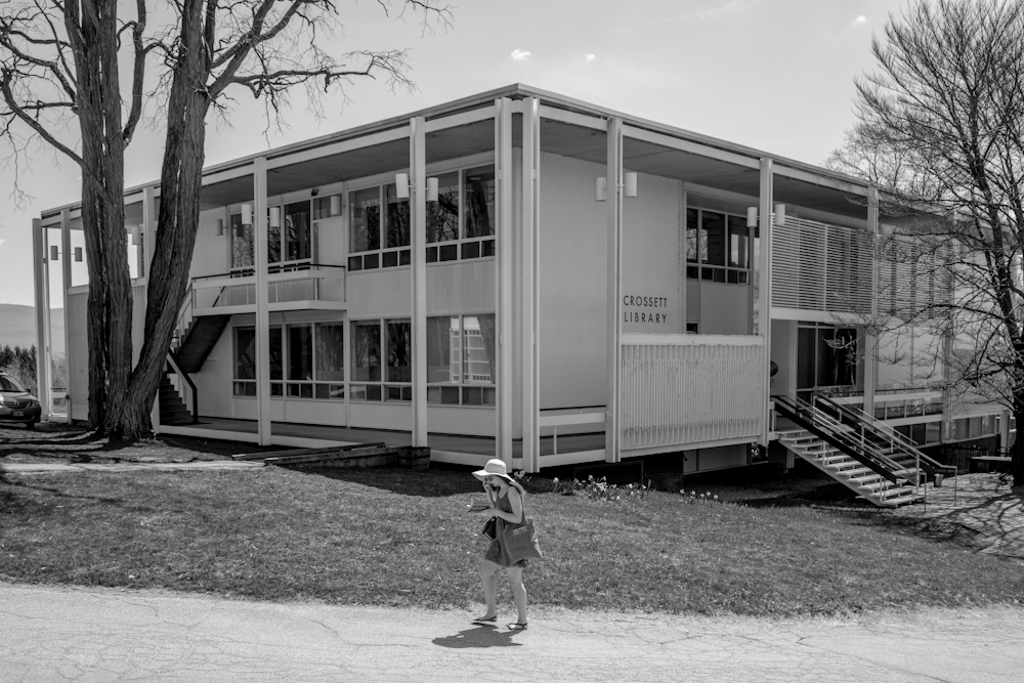
By the 1950s Bennington's image of progressivism demanded that the college library be a distinctly modern building by a nationally famous architect. At the same time, the college also sought a building that stressed forthrightness and informality rather than show, and that suited the character of the modestly scaled rural campus. Belluschi's considerable experience with library design (including Reed and Willamette colleges) as well as his successful regional modernism, seen in buildings such as the Central Lutheran Church (1950) in Portland, Oregon, made him an obvious choice for the college. He produced a white, two-story building raised above a ground story with a rectangular concrete frame, a flat roof, and a peripteral gallery measured into finely proportioned bays by delicate vertical steel fins that carry horizontal wood-louvered sunscreens. These were concepts and details he had used in Oregon, as on the Central Lutheran Church. The rhythms here are classical and the sense of measured frame is Miesian. The architect likened the fins to Colonial Revival pilasters. The louvers invoke the patterns of clapboard, and the wood and the white color resonate with the residence halls below. Overall, Belluschi controlled the scale by setting one floor below grade and established a clear relationship with the landscape with stone walls, brick paving, and a garden reading court. The insertion of a decidedly modernist building into an aesthetically conservative context generated polarized discussion in professional journals, including Architectural Forum (February 1960). Nevertheless, the library was honored in 1960 as one of the four best new libraries in the nation by the AIA's Library Buildings Award Program, the American Library Association, and the National Book Committee.
Crossett Library
1957–1959, Pietro Belluschi with Carl Koch and Associates; Sasaki Associates landscape