

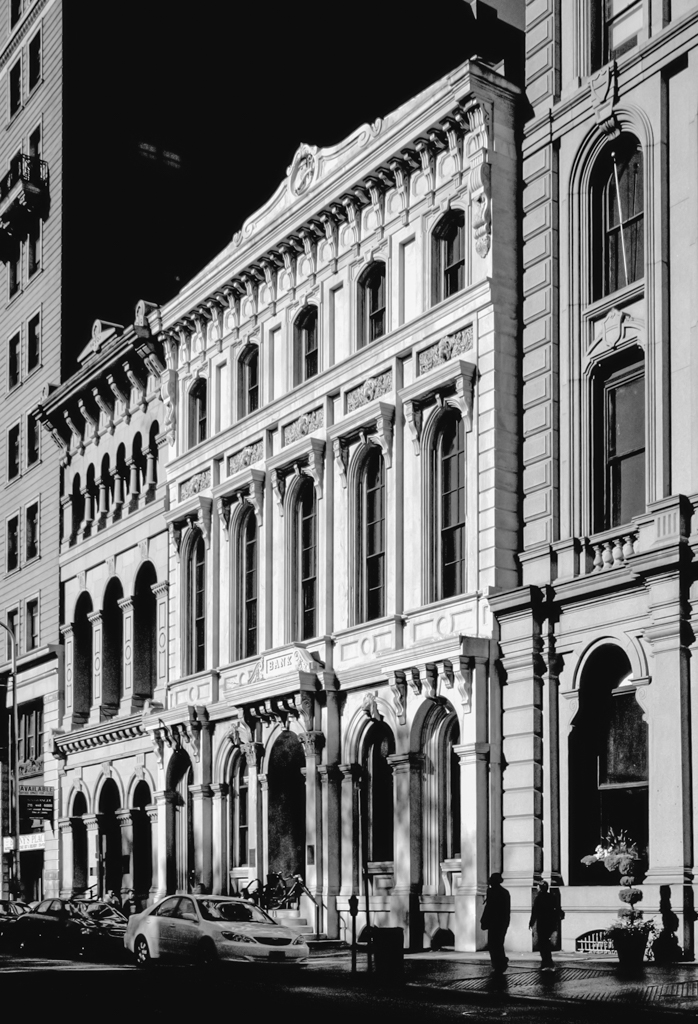
This bank's white marble facade was a link to the classical architecture of the banking district, while its Renaissance-style design denoted links to the transatlantic financial culture. The bank was founded in the early nineteenth century to serve the growing ranks of tradesmen who were typically cut off from financial services. Gries also designed the adjacent Bank of Pennsylvania (also known as the Philadelphia Bank) in 1857–1859, using gray granite for its facade. The latter bank carries the motifs of plow and anchor, the symbols of the city. Monumental cast-iron doors are emblems of the hoped for security of the institutions, while the regularity of the facades and their references to Italy are links to the Florentine bankers whose palaces set the standard for bank design. The Bank of Pennsylvania has added interest in Gries's use of cast-iron beams placed in tension by massive steel cables to span the great banking room. With Addison Hutton's Pennsylvania Company for Insurances on Lives and Granting Annuities (1871–1873) just to the west, some hint of the architectural unity of the row can be gauged. To the east are a few of the remnants of bank row. At 317 Chestnut Street is John McArthur Jr.'s monumental First National Bank (1864–
Farmers' and Mechanics' Bank
1854–1855, John M. Gries. 427 Chestnut St.