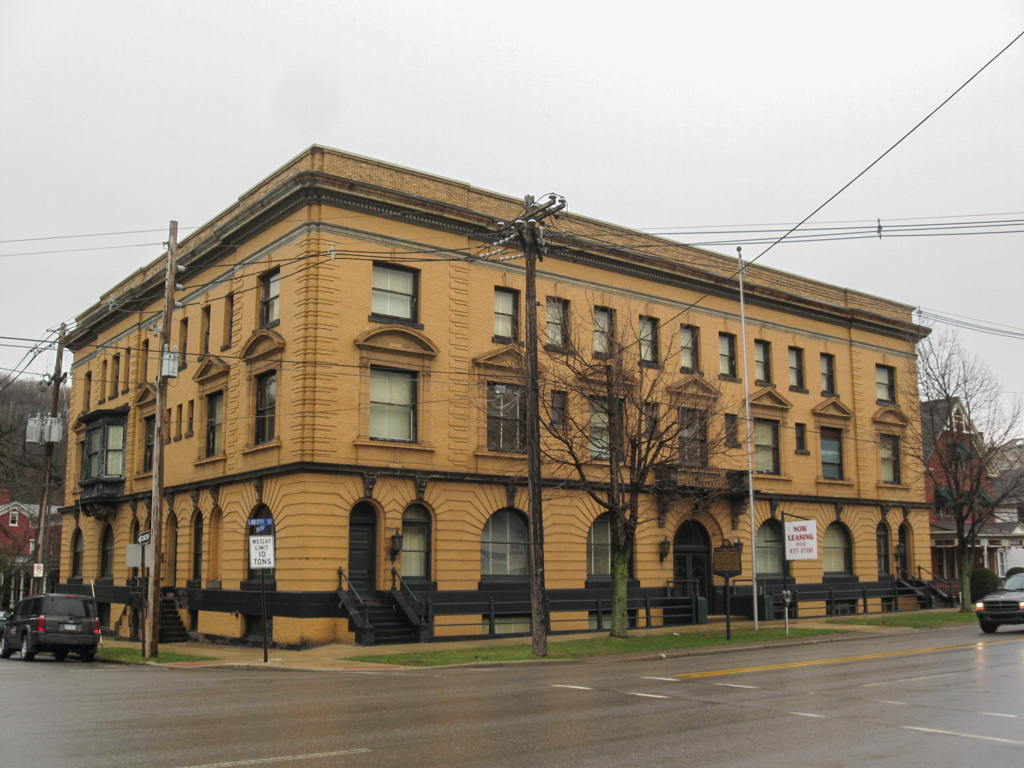
This building served as the headquarters of the Galena-Signal Oil Company until 1931. In 1869, Charles A. Miller and two partners purchased a small Franklin oil company where they added galena, a lead oxide, to Pennsylvania crude oil to make a railroad lubricant able to withstand variations in temperature and pressure. Miller's brother-in-law, Joseph Crocker Sibley, improved the valve oil substantially until Galena Oil's Perfection Valve Oil outsold all others. Sibley, a self-taught engineer, also refined oil that could be lit and used in signal lamps. He became president of the Signal Oil Company after 1875, and by 1902, the two entities were consolidated as the Galena-Signal Oil Company. Although Miller and Sibley maintained their shares until 1911, John D. Rockefeller's Standard Oil held the controlling interest due to the international scope of sales.
This three-story, Renaissance Revival golden brick building has a rich variety of different window treatments, from round arched on the first story, to round arched and pedimented on the second story, and to simple square-headed sash windows on the third story. A heavy cornice and water table as well as brick corner quoins complete the ensemble designed by New York City architect Edgar Bourne.