

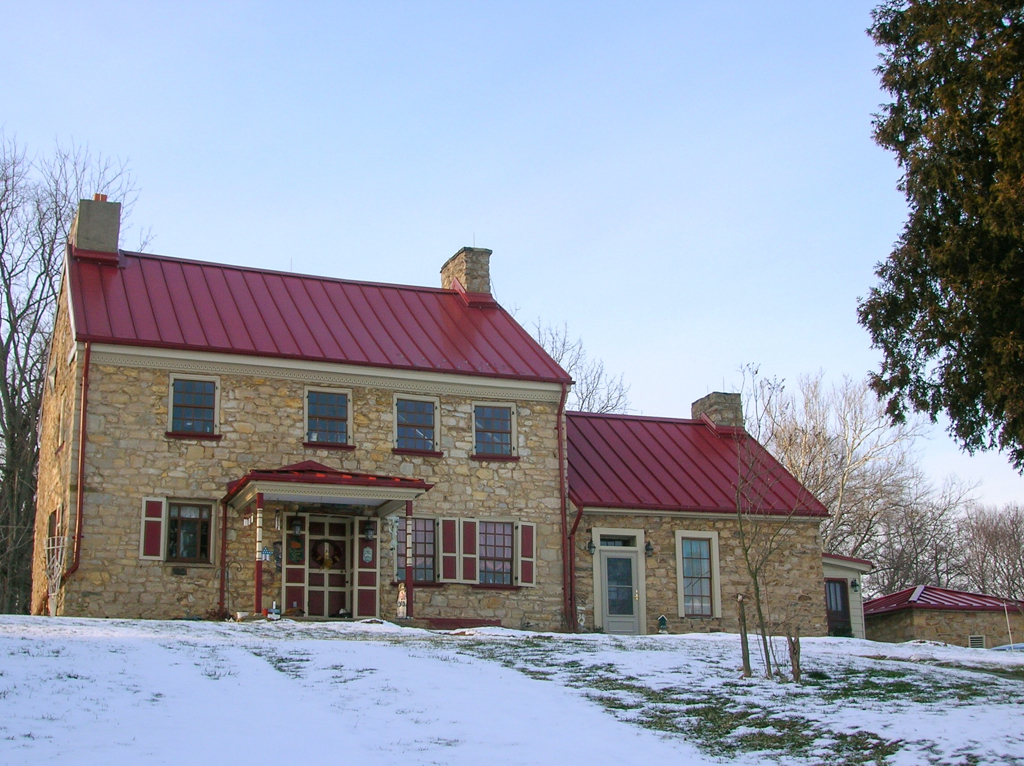
Edward Cook came to western Pennsylvania from Lancaster in eastern Pennsylvania in 1770, and began construction of this house two years later from limestone quarried on his property. It was one of the largest houses on the frontier, measuring fifty-eight feet in width and twenty-eight feet in depth. The stone, laid in a random pattern popular in eastern Pennsylvania, was intended to be stuccoed. The house has a central hall and four rooms on each floor, two larger rooms at the front (south) and two smaller chambers at the rear. Chimneys are interior end, and the chimney on the west elevation marks two fireplaces in a “turkey breast,” or triangular, arrangement. Many of the double-sash windows retain their original glass, eight by eight on the upper story and twelve by eight on the first story. A one-story, one-room stone addition built before 1798 contains a twelve-and-a-half-foot-wide cooking fireplace. Cook, who served in the Revolutionary War, was a member of the Provincial Congress and counseled moderation during the 1794 Whiskey Rebellion. This house and its stone springhouse are extraordinary artifacts of the eighteenth century, and have been restored by Cook's descendants, who operate the neighboring farm from a large Colonial Revival red brick house and frame Pennsylvania barn.
Colonel Edward Cook House
 Lu Donnelly
Colonel Edward Cook House
1774–1776. 347 Cook Rd., 2 miles north of Fayette City