

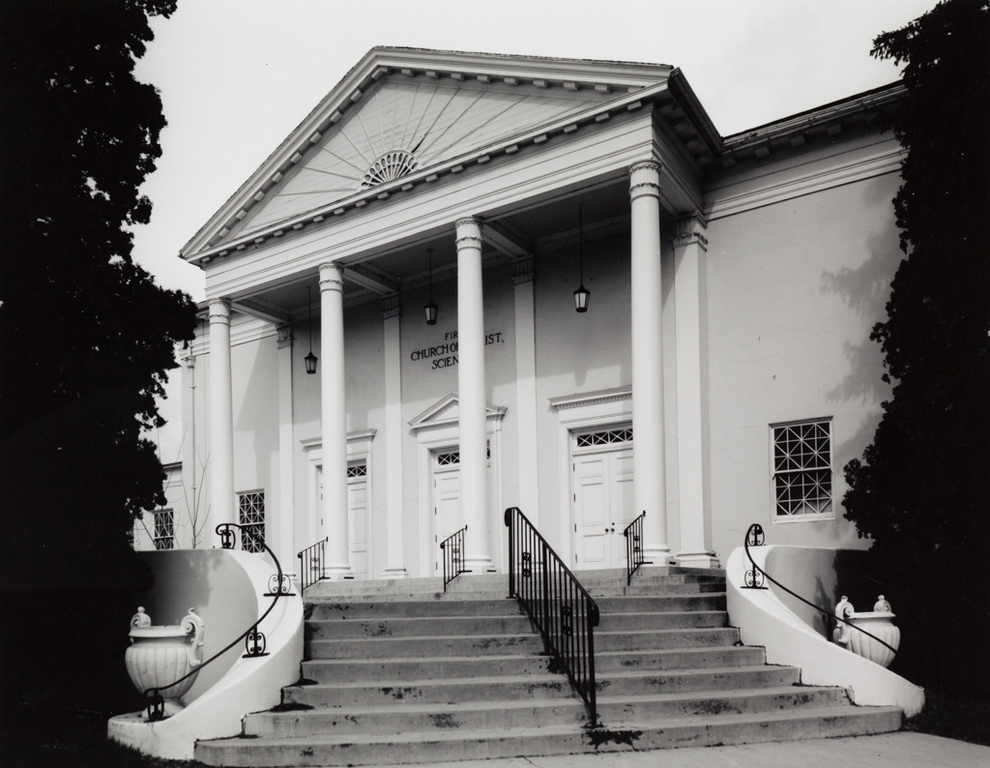
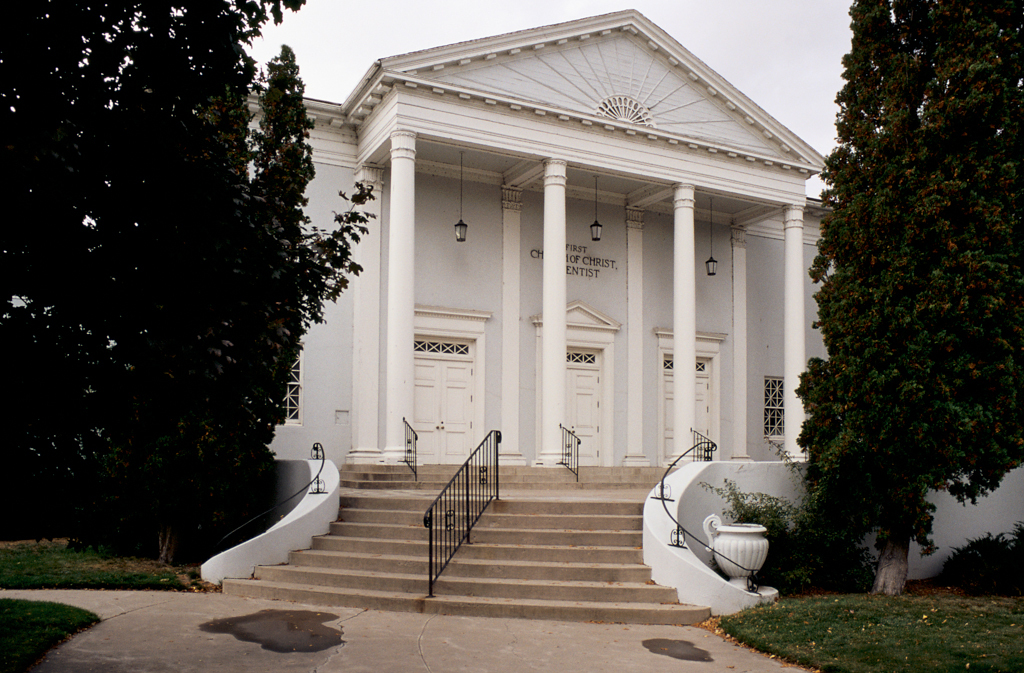
Paul Revere Williams, the best-known African American architect in Los Angeles, designed this church during the height of the Colonial Revival in the 1930s. The church has a dramatic, rather theatrical entrance under a
Williams's Los Angeles commissions include the Theme Building at Los Angeles International Airport (designed with Pereira and Luckman and Welton Becket and Associates) and numerous mansions for movie stars and businessmen. He also designed a residence (589–599 California Avenue) in Reno's Newlands neighborhood and the Loomis Manor Apartments, as well as the La Concha Motel in Las Vegas, whose curvilinear lobby has been preserved as part of the Neon Museum.
When the First Church of Christ, Scientist moved to another location, local arts patron and congregant Loya Lear launched a campaign in 1997 to repurpose the building as a medium-sized theater. She had acquired her love of the theater from her father, a Broadway vaudeville performer. Lear donated $1 million, which was matched by the local Theater Coalition. Varous theater groups used the Lear for about a year, while the renovation began. But in 1999 the theater closed, since work was progressing slowly.
The delicate balance between maintaining historical integrity and providing for the functional needs of a modern theater has proved difficult, and the organization considered four different design proposals between 1999 and 2009. An expanded lobby and rehearsal spaces, part of the original plan, were not feasible due to the historic structure of the building. Moreover, plans for two basement performance spaces were cancelled due to sound leakage and also because the building's location near the Truckee River caused flooding. Another design challenge was converting the church interior with a raised pulpit into a theater space with a lower stage. However, some work has been completed, including a new roof, lead paint removal, and window repairs.
In 2011, Artown, the nonprofit responsible for staging Reno's month-long summer arts festival, assumed ownership of the Lear Theater. The group initially planned to turn the building into an arts center, but in 2013 realized that the organization could not afford to carry out such a plan. Artown sponsored a competition to essentially donate the theater to a local performing arts organization, provided that it would be properly restored. The Sierra School for the Performing Arts won the competition, but the deal did not go through due to the estimated $5 to $7 million still needed for the restoration. As of early 2020, the theater remains dark, its future still uncertain.