

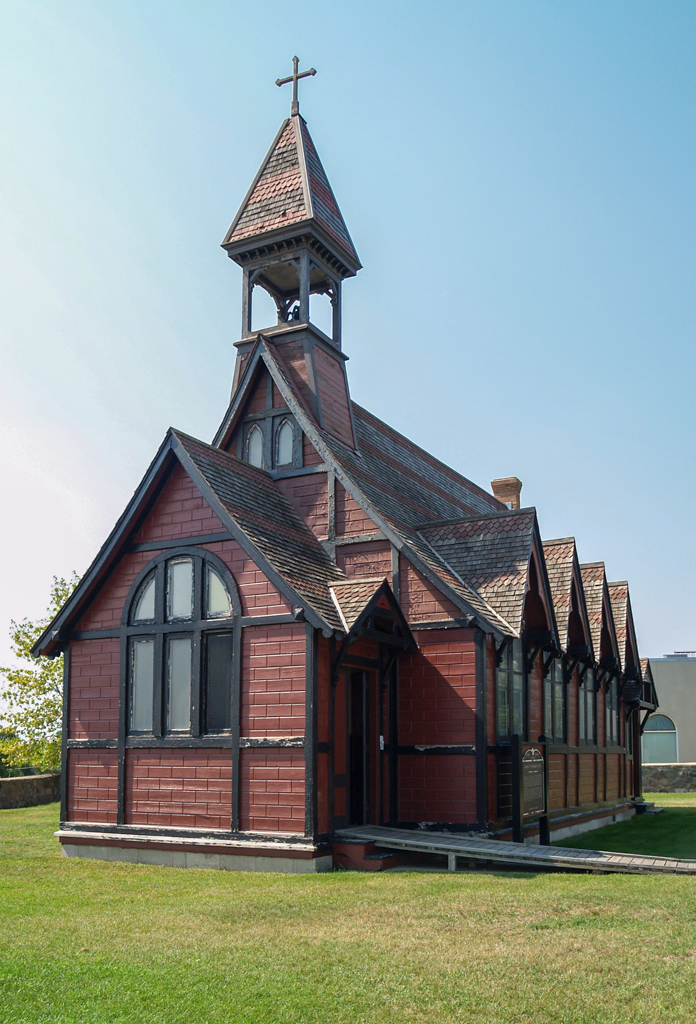
Before the establishment of the Missionary Diocese of North Dakota in 1883, Episcopal Church affairs were administered from Omaha by Bishop Robert Harper Clarkson. Bishop Clarkson was concerned that an appropriately dignified image of the faith should be set on the American frontier, so he regularly called upon the talents of eastern architects to establish a minimum standard for church architecture. For Bismarck, Clarkson secured a design from British immigrant and New York City architect Henry G. Harrison, who was at the time designing Clarkson’s Trinity Cathedral in Omaha. Episcopalians fostered the Society of the Double Temple, a sister parish relationship that paired a frontier congregation with an established one in the East. This relationship provided funding and the unusual dedication needed to realize northern Dakota’s earliest Episcopal churches. The church’s mixed Stick Style and Gothic Revival charm may seem more appropriate for a summer chapel in the Catskills than the bleak treeless expanse of the Dakota prairies. Harrison’s design was implemented by A. E. Hussey, a young architect connected with the lumberyard in Mandan. The picturesque building stood lonely and almost inaccessible in winter near downtown Bismarck, until 1965 when it was relocated to Camp Hancock, where it serves as a chapel that is used occasionally for special services and weddings. Camp Hancock was established in 1872 to provide protection to the crews building the Northern Pacific Railway. Today this state historical site includes a museum housed in the surgeon’s quarters (1872) and an NP locomotive (1909).
Bread of Life Episcopal Church
1879, Henry G. Harrison; A. E. Hussey. 101 E. Main Ave.