

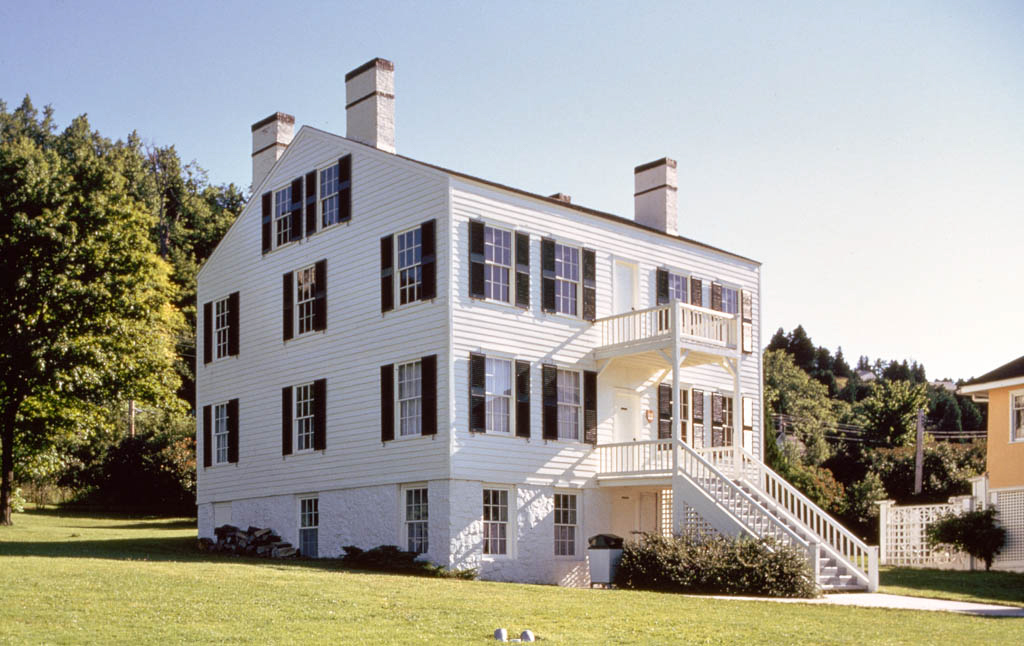
Built in 1838, this square wooden structure served as the office and living quarters for U.S. Indian agent Henry Rowe Schoolcraft, and as a dormitory for Indians visiting the post on business. As a result of the Treaty of Washington (1836) between the Ottawa and Chippewa nations and the United States, the Indians ceded to the U.S. government two-thirds of the western half of the Lower Peninsula and the eastern half of the Upper Peninsula. The government agreed to provide temporary lodging for Indians who came to Mackinac to conduct business with the agent and to secure trade goods. In 1850 the building became a dormitory for Indian children, and in 1869, a school for island children. In 2010, Mackinac Island State Park opened an art museum displaying Mackinac Island artwork here.
The former Indian dormitory has a simple, symmetrically arranged square plan and is two stories in height on a full exposed foundation. A single flight of stairs rises to the central entrance, which is surrounded with a transom and sidelights and flanked by six-over-six windows.