

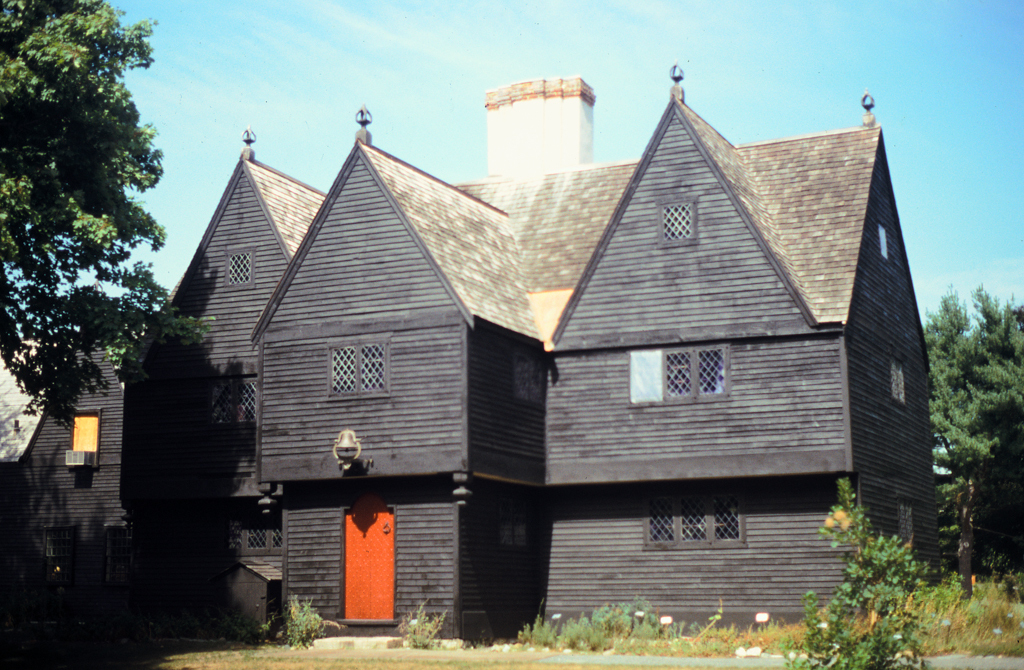
This structure was once thought to be the home of the seventeenth-century Saugus Ironmaster. Samuel Appleton Jr. of Boston acquired the defunct ironworks about 1682, and a “mansion house” is mentioned as located here the next year. Dendrochronology, however, suggests a date of 1690. Declining into a factory tenement, it was acquired in 1915 by Pilgrim Century antiquarian Wallace Nutting, who set up his factory for reproduction colonial furniture in the nearby Scott Mill (SA4). Nutting believed the larger the hearth the earlier the date and thought the hall's wide fireplace “proved” a date of about 1640 (even before the ironworks was established). He named the house Broadhearth. With Henry Dean, Nutting transformed it into one of his historic “picture houses.” Exposing its highly elaborate oak, postmedieval frame and original chimney, he also discovered evidence to re-create a projecting porch (demolished by 1793). Like the porch, the facade gables, jetty drops, finials, casement windows, part of the stairway, and other interior finishes are all Nutting's work. He also removed the eastern half of a two-story eighteenth-century addition to restore the house's classic lean-to profile. The National Park Service has since added to his imaginary interiors reproduction furnishings typical of wealthy late-seventeenth-century Boston families like the Appletons.
Appleton-Taylor-Mansfield House, Saugus Iron Works
 Keith Morgan
Appleton-Taylor-Mansfield House
c. 1682–1690; 1915 restored, Henry Dean with Wallace Nutting. 244 Central St.