

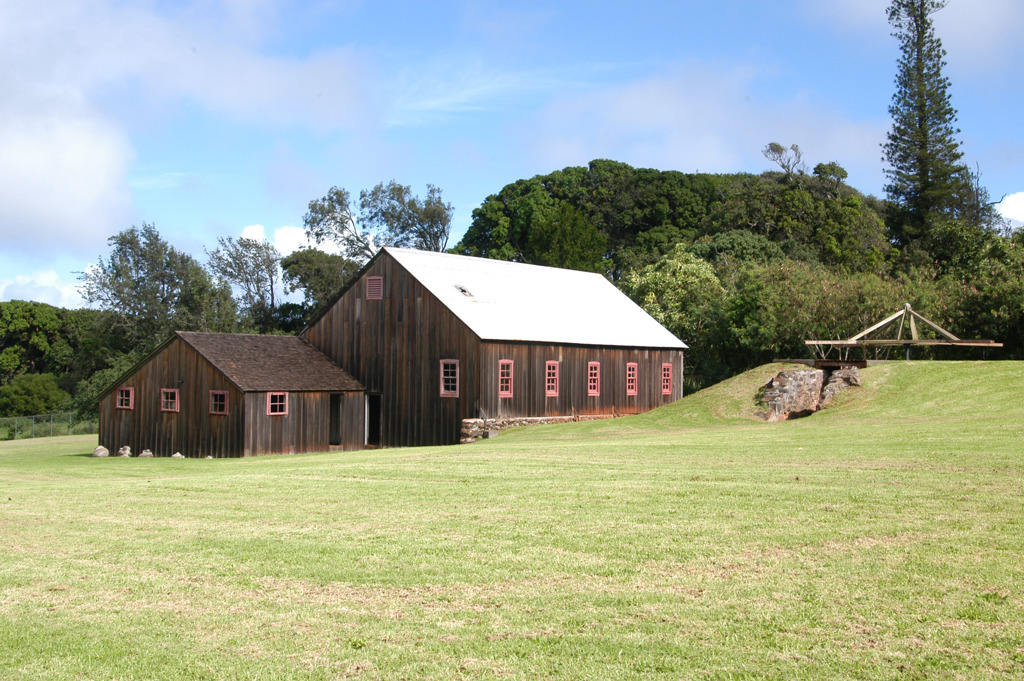
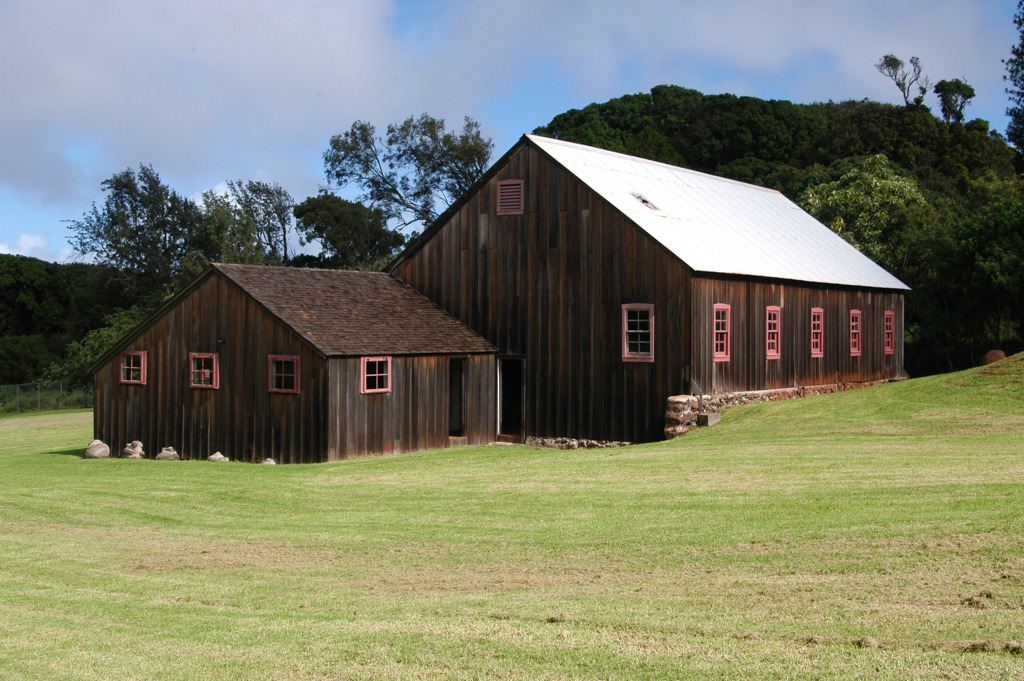
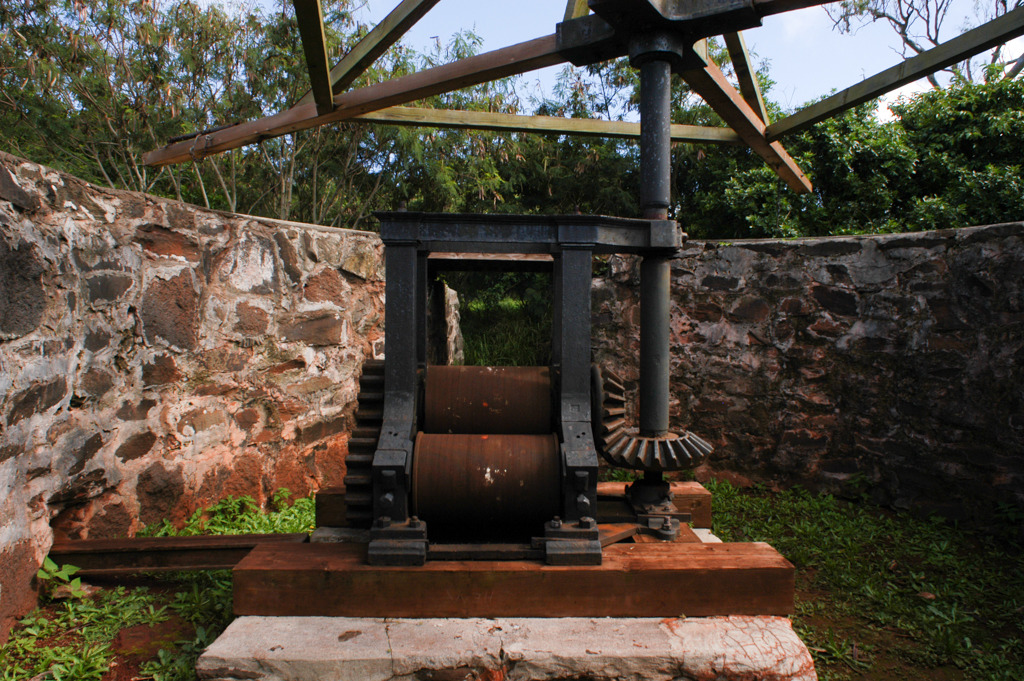
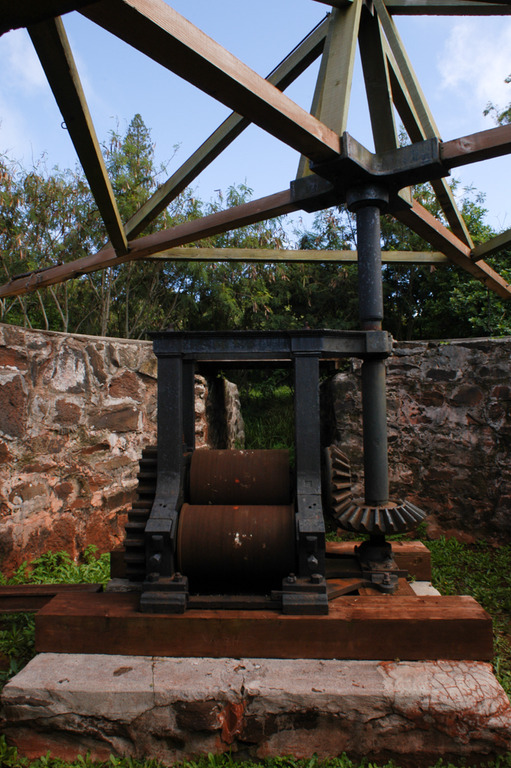
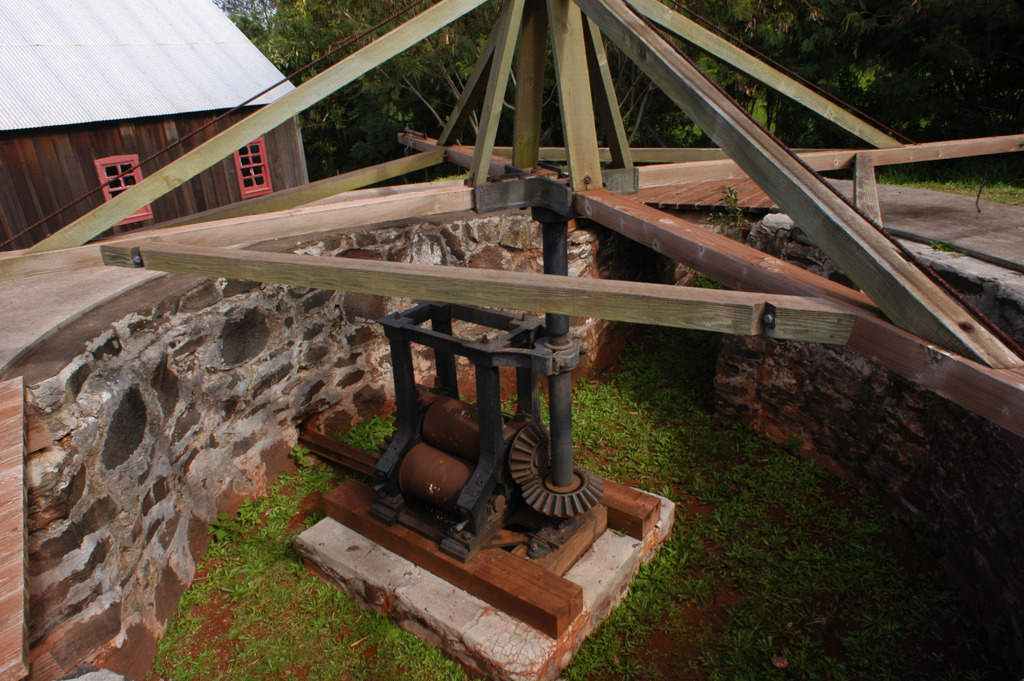
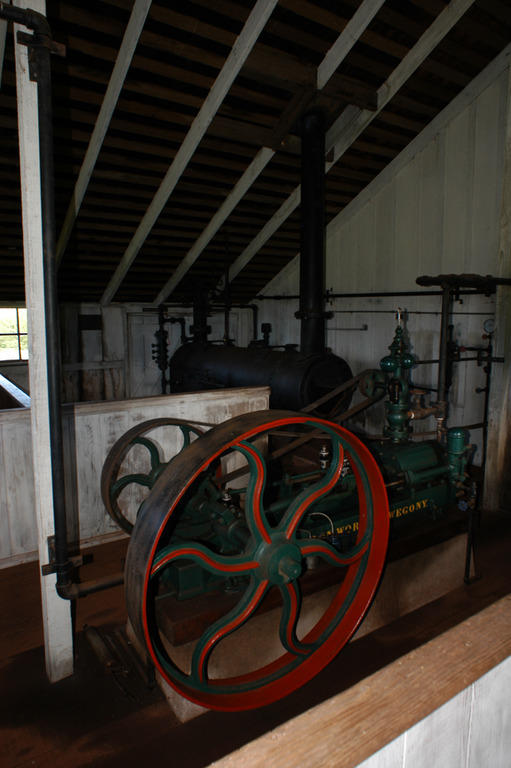
Almost obsolete when it was built, the sugar mill operated by R. W. Meyer is now a National Historic Engineering Landmark. It is a rare example of mid-nineteenth-century sugar processing technology. The three-roller, cane-crushing mill was manufactured in Liverpool, England, by Edwin Maw sometime during the period 1855–1870. Set within a circular berm and powered by mules, oxen, or draft horses, the secondhand equipment was sadly out of date when R. W. Meyer acquired it in 1878. The last animal-powered sugar mill to operate in Hawaii, the mill suited Meyer's purposes, and for the decade it was in operation, it produced a marginal profit for its owner. The operation included the crushing mill, which extracted the sweet juice from the cane, and the boiler house, a simple gable-roofed, board-and-batten building. The latter housed the furnace, sorghum pan, and cooling pans, which reduced and evaporated the juice into thick syrup of a nearly crystalline state. In 1879 Meyer acquired two centrifugals to facilitate the process. He also purchased a steam engine and boiler, manufactured by Ames Iron Works in Oswego, New York, to power the centrifugals. Once the mill ceased operations, the site was benignly neglected. It sat and slowly decayed until the 1980s, when it was restored under the guidance of David Curtis. The mill represents a minor and not overly successful moment in the history of sugar in Hawaii. By 1882, six years after the Reciprocity Treaty which allowed sugar from the Kingdom of Hawaii to enter the United States duty-free, 39,350 acres of sugar cane were under cultivation in the Islands. Of this total, Molokai could only claim three hundred acres, and of the three plantations on the island, Meyer's was the smallest, comprising no more than thirty-five acres. This operation was not only the smallest on Molokai but the smallest in the kingdom.
R. W. Meyer Sugar Mill at the Molokai Museum and Cultural Center
1878; 1977–1988 restored, David Curtis. Kalae Hwy., between mile markers 3 and 4