

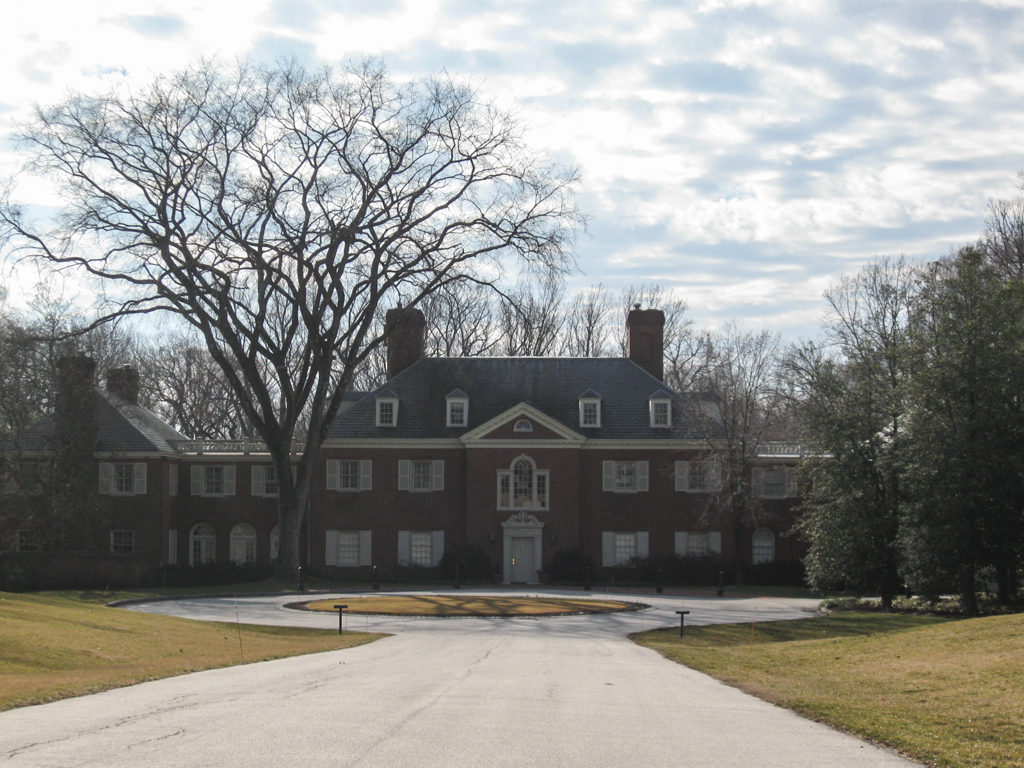
The 28,000-square-foot, Georgian Revival mansion was home to Pierre S. du Pont III, corporate executive and leader in the development of cellophane and nylon. His son Pete, who grew up here, would later become governor and run for U.S. President. A brick house that suggests the architecture of Tidewater Virginia, with a Palladian window above a Westover-style doorway, the mansion lay at the center of a scenic estate named Bois-Des-Fosses for the family property in France. Following Pierre's death in 1988, the land was subdivided—with more sensitivity than might have been expected—and Bois-Des-Fosses was purchased by the DuPont Company in 1991. Demolition was considered, but instead the place was refurbished as a venue for conferences and weddings and given a new name, Brantwyn. The surroundings are historic; to the east, stone gatehouses mark the entrance to Lower Louviers (1810–1811, much rebuilt), a private estate not visible from the road. Porticoed Lower Louviers was designed for Victor du Pont by his brother and fellow immigrant, E. I., supposedly with the assistance of Thomas Jefferson. Its restoration in the 1930s was the first local design project of architects Victorine and Samuel Homsey. Nearby Upper Louviers (pre-1802, 1830s, and later), immediately east of Brantwyn, was home to Pierre Bauduy and, from 1837–1865, Admiral Samuel F. Du Pont. Despite these associations, Upper Louviers was razed for an extension of the DuPont Country Club golf course in 1978.
Brantwyn (Bois-Des-Fosses)
c. 1935, Massena and du Pont. 1939 garden, Frederick W. Holcomb. 600 Rockland Rd.