

The DuPont Company undertakes research and development at this facility. A predecessor station was housed in Rokeby mill (near Breck's Mill,
CH19
), which burned in 1906. Fortunately, larger quarters were already underway at this site, then called Lower Yards. Number 1 Building, housing shops, offices, and laboratories, was built in a Colonial Revival style of glazed-header Flemish bond brick-work, as were several of the early structures at the facility, huddled along the riverbank. By the 1930s, 1,000 scientists worked here in the largest such station in the United States. In Building 228, Wallace Carothers had discovered the chemical forerunners of neoprene and nylon in April 1930 (see Seaford Plant,
WS17
). Thanks to these and other breakthroughs, company assets grew more than seventy times between 1902 and 1940. On the hilltop rose the International Style brick buildings of an expansion in 1948–1949, arranged campus-like around a grassy mall. The J. Tyler McConnell highway bridge over the Brandywine (1952) granted access to the enlarged facility. That bridge featured some of the first hammerhead-shaped concrete piers in the United States (currently proposed for replacement, which some have protested on historical grounds). Prominent along DE 141 is the huge, postmodern-style Crawford Greenewalt Laboratory (1981–1984, Kling Partnership). At a 2003 celebration of the Experimental Station's centenary, a time capsule was filled with a hydrogen fuel cell and other futuristic products that, it was hoped, would eventually help revitalize the shrinking DuPont Company.
DuPont Experimental Station
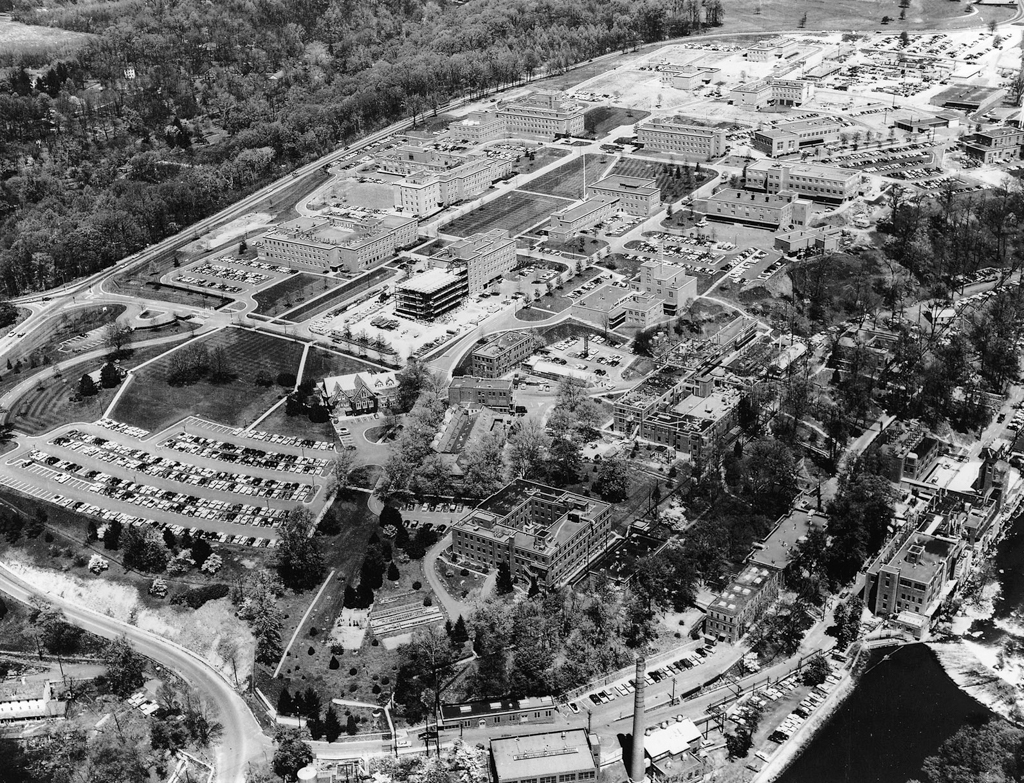 Hagley Museum and Library
DuPont Experimental Station
1906 established. Along Brandywine Creek south of DE 141 (best seen from Rockford Park)