

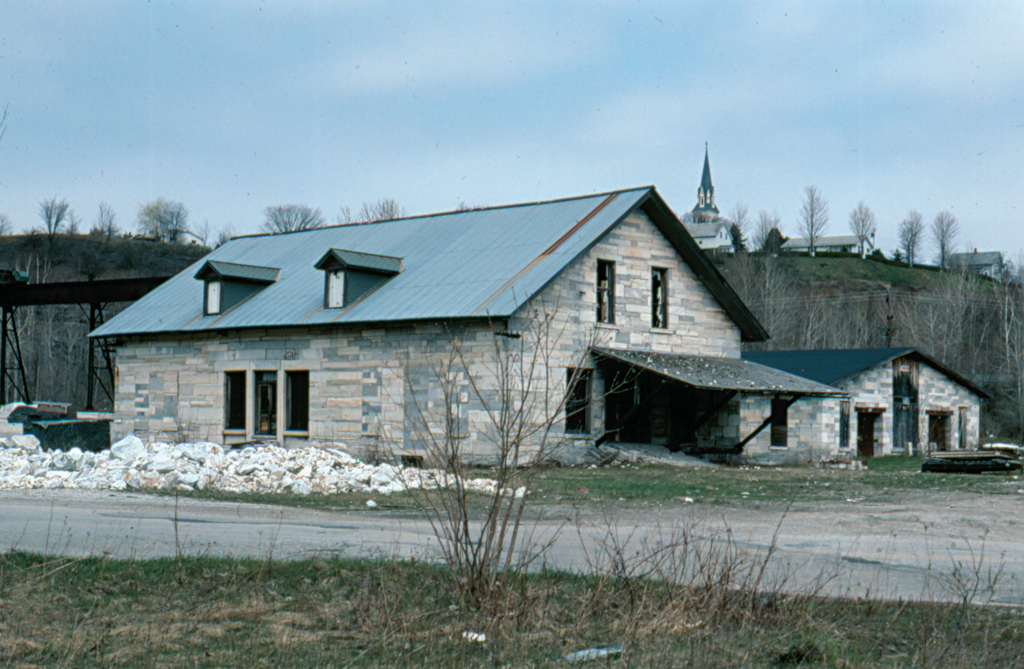
The Sheldon and Slason company erected this simple, one-story stone building as a store at their West Rutland marble quarry. Built of random marble ashlar blocks with a simple gable roof, it is the earliest remaining structure associated with the Vermont marble industry, which powered the Rutland-area economy from 1850 until the Great Depression.
After completion of the Rutland and Whitehall Railroad in 1850, including a spur line north to the quarries, partners Charles Sheldon and Charles Slason opened a marble works, retaining many of the Irish immigrants who had built the railroad to work here. The plain surrounding the quarries was called “Red City” because of all the red-painted shanties that served as housing. While working in the quarries, laborers had accounts at the company store for food, clothing, and other necessities that had to be settled before they received any cash payment of wages.
The store faces west with a central doorway, a large window to each side, and two dormers on the roof. The south end of the building was extended by one bay in the late nineteenth century, and a shed-roofed loading porch covers most of that gable end. Boarded up and empty for a half century, the store has recently returned to life as a gallery and offices of the Vermont Carving Studio and Sculpture Center.